Ronald Thwaites | Treacherous political and economic waters
Loading article...
-
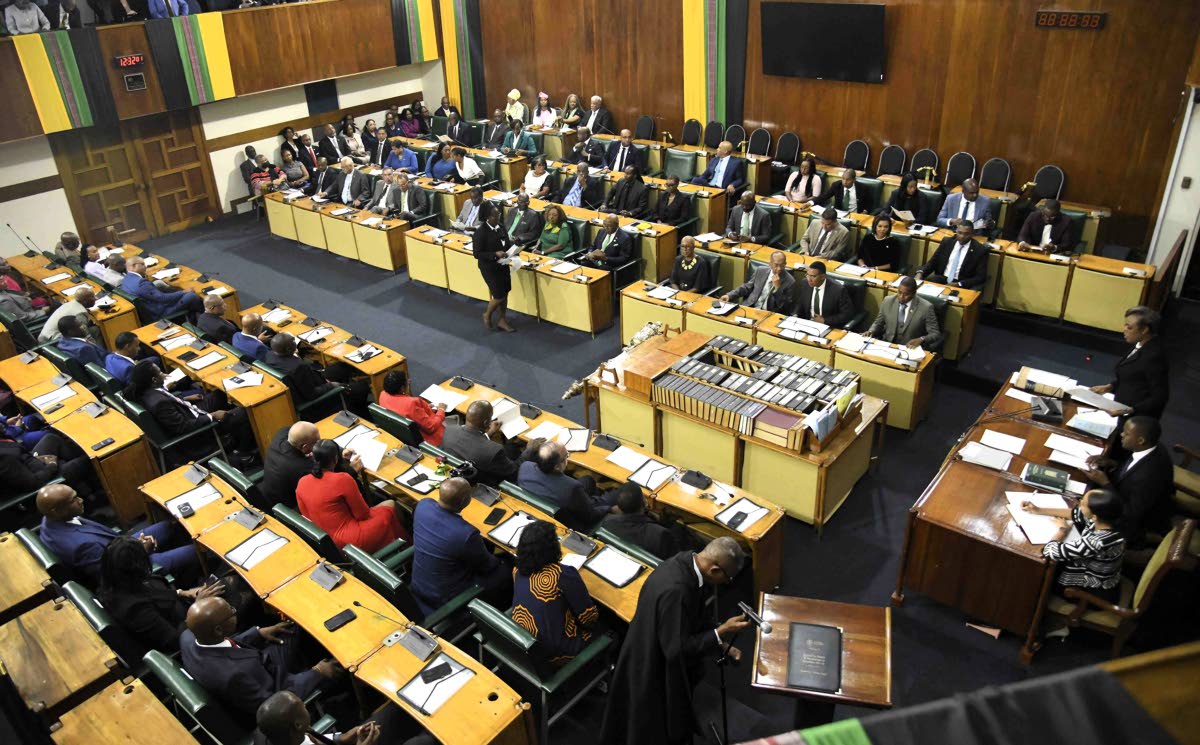 Members of Parliament before at the swearing-in ceremony for members of the upper and lower houses of Parliament held on September 18, 2025 in Gordon House. Photo - File
-
Members of Parliament before at the swearing-in ceremony for members of the upper and lower houses of Parliament held on September 18, 2025 in Gordon House. Photo - File
-
 Ronald Thwaites. Photo - File
That is what our leader says Jamaica is facing. Most of us knew this to be the case long ago. We live that unsettling truth every day when we go to the shop or buy gas. Oligarchs and fellow travellers can cite improved growth rates and other impressive aggregate indicators. The majority experiences a grimly different reality.
We also know that the most politically important decision is not the choice between the Jamaica Labour Party (JLP) and the People’s National Party (PNP), or socialism versus capitalism. It is between those who think today’s economic and social order is fair and working well for most people and those who do not. The supporters of each position present a different narrative on most national issues. They conflict dramatically.
The nation cannot progress because of this implicit clash of values. Democracy only works if we abide by at least two principles. The first is to respect our common humanity, seeking ways to work together across political, class, racial and religious divides to uphold shared values of freedom, human rights and individual dignity.
The second principle is a commitment that violence and cruelty should have no place in our polity. With those convictions riveted in our souls and psyches, we could withstand any of the political and economic turbulence facing Jamaica.
It is the function of all national leadership to expose public affairs and give example, by word and deed, of the best of who we are and what we stand for as a community.
How did Parliament last Tuesday, and recently, measure up to those standards? Are they reflected in how we craft and spend the national budget? Are they the centrepiece of the value proposition that guides public education?
THE ECONOMY
Last week, the chasm between the two narratives expanded. The official version about the economy is that the Melissa recovery project is going swimmingly well.
“Excellently,” says the same source who, in the next breath, predicts the treacherous waters in which, like the residents of Parottee, the rest of us dwell.
Which is true? Come West with me and find the answer. Then, hear the rebuttal: “Bad mind! Don’t you get back light? Be patient. NaaRA soon come”.
Economic decline for the quarter is less than expected. Okay. Please explain how prosperity, or even just survival, can be birthed from the womb of an out-of-control trade deficit, low government revenue, higher borrowing costs and aggressive public-sector wage demands, unhinged from improved productivity.
We are “leaving ourselves careliss”! Why import nurses from halfway across the world when we have an abundance of nursing talent locally waiting to be trained for local and foreign service?
I remember in the ‘70s when Michael would try to persuade Aggrey Brown and myself to see progress when the IMF had enacted “only” a one per cent devaluation that month.
The irreconcilable narratives continue. The Private Sector Organisation of Jamaica (PSOJ) and foreign investors are told of soon-come highly productive, digitally savvy, coding-adept workers who will transform us into the Singapore of the West. Hope does not deceive, but predicting mirages is false statecraft.
It is hard to have confidence in any promise of greater labour capability when almost half of Grade 7 students have serious and uncorrected deficiencies in language, numeracy and social-emotional stability. Can’t we agree that settled behaviour and the capacity to read, write and compute are prerequisites for all improved outcomes?
No wonder we are not being allowed to come to grips with the full details of the recent CXC results. It is the Jamaica Teachers’ Association (JTA) head who says we “normalise failure”. She is right. Sadly, many teachers are part of it. What is the powerful teachers’ union going to do about it anyway?
THE DOCTORS
In the health sector, instead of following up on the Industrial Disputes Tribunal (IDT) and insisting that it perform like a national institution fit for purpose, the Government is scurrying to provide pinch-hit medical care, already deficient unless you have money. Why not offer a part payment to the doctors while the IDT continues to scratch its head?
Check the narrative: We who are well fed expect the doctors to work 24-hour shifts while tolerating the contempt of not even having a fixed date to receive fair overtime pay.
Meanwhile, clinics and surgeries are cancelled and the poor suffer pain, fear and death. Contrast that with Leo XIV, who told us last week: “The poor, for Christians, are not a sociological category but the very flesh of Christ.” Do we believe that?
AN MP’S FUNCTION
Parliamentarians are crying out for an increase in the Constituency Development Fund (CDF). It is justified but ultimately distorting. Without the CDF, an MP has no leverage to respond to the urgent needs of constituents. One becomes an easy pawn of wealthy benefactors or a bruk-pocket disappointment to one’s people.
But access to public money makes the representative more of an inevitably partisan social worker and less of a legislator. Even if you are a minister, your role in crafting common-cause policy and good laws is a secondary concern.
Why not develop a proper welfare and works system where impartial and efficient state agents disburse public assistance and manage constituency works projects, overseen and monitored, of course, by MPs and councillors?
But that would require a big change in political culture, wouldn’t it?
REFORM?
Senator Sherene Golding Campbell is right about national progress being contingent on reform of the public service. I heard a minister acknowledge recently that the entity he or she leads was “not fit for purpose”. Do we realise the gravity of those statements?
The trouble is that no single political entity can effectively renovate the public service or do anything else radical, except lurch into autocracy and managed decline.
That reality is the crux of the “treacherous political and economic waters”. It is avoidable, though.
Rev Ronald G. Thwaites is an attorney-at-law. He is former member of parliament for Kingston Central and was the minister of education. He is the retired principal of St Michael’s College at The UWI. Send feedback to columns@gleanerjm.com.