Rabbi Yaakov Raskin | The rabbi who refused to give up on anyone
Loading article...
-

-

Rabbi Menachem M. Schneerson, the Rebbe, meeting with New York City Mayor David Dinkins in September 1991.
Photo credit: Rebbe Drive. -
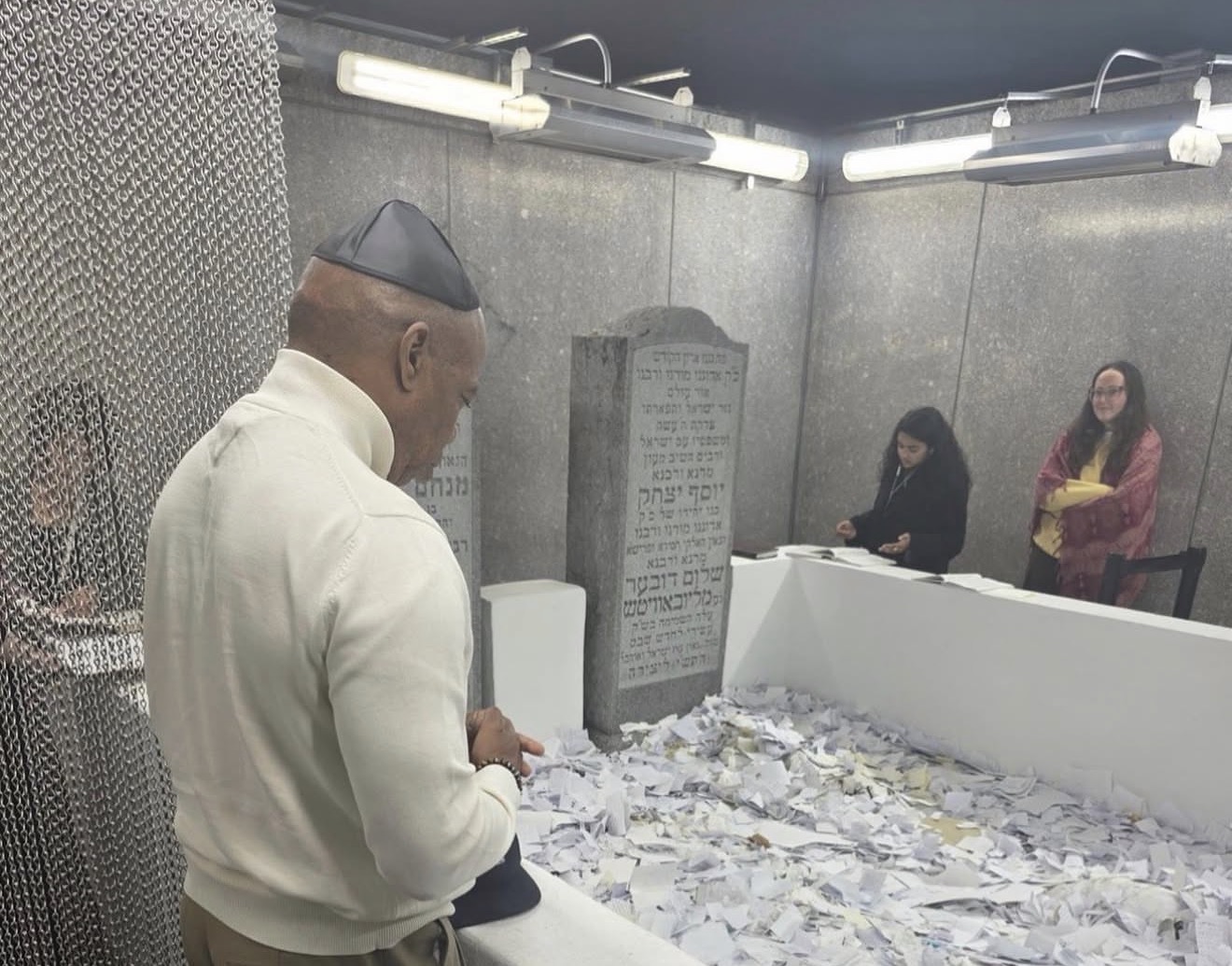
Former New York City Mayor Eric Adams at the Ohel.
Credit Chabad.org
A suicidal teenager was about to end it all. Overwhelmed by the world’s problems, he was depressed and felt like life had no meaning. He had been in and out of psychiatric hospitals when his friend told him as a last ditch effort, he should write a letter to a holy rabbi in Brooklyn. With nothing to lose, the young man wrote the letter, not expecting an answer, but hoping perhaps the rabbi might be able to help him with his problems.
That rabbi was the Rebbe, Rabbi Menachem Mendel Schneerson, the long-time leader of the Chabad-Lubavitch movement. A visionary leader who revitalised Jewish life globally following the holocaust, the Rebbe provided spiritual and emotional guidance to tens of thousands. He is best known for establishing a network of emissaries, or “shluchim”, who helped transform Jewish life in over 111 countries, and who shared the Rebbe’s message of light and love with humanity.
Despite his extremely busy schedule, the Rebbe responded to the troubled teen. Rather than coddling him, the Rebbe gave him a challenge. “You must get away from yourself, and begin to think of others,” he wrote. “It is time to begin an active participation in society; to give, and to give generously. The opportunities are many and the need is great.”
This advice worked. While it took many years, the Rebbe kept in touch with this teen, who eventually achieved a state of psychological balance. He went on to become a professor of religion and was able to help thousands of other young people who struggled with the same questions he himself once faced.
I find Rebbe’s approach remarkable. Instead of trying to convince the teen to not jump off the metaphorical bridge, he challenged him to walk bravely into the world he was running away from. The Rebbe saw the teen as not only capable of recovering from his mental illness, but as a powerful beacon of light to help solve the problems that he was troubled by.
This story is by no means intended to suggest that clinical solutions or therapy are not useful. In fact, the Rebbe encouraged everyone with mental or physical illness to consult with the best doctors available. Yet his approach – challenging the young man’s sense of victimhood and encouraging him to take bold positive action – was exactly the medicine he needed.
This story was a reflection of how the Rebbe approached everything in his leadership. Following the Holocaust, when many Jews were downtrodden and lost faith, the Rebbe taught that not only could they bounce back, but that they could be stronger than ever.
In his decades of leadership, the Rebbe advanced the mission of making the world a more spiritual and holy place. He preached that everyone, no matter how far they thought they were from G-d and holiness, had a divine spark in them waiting to be ignited. No one was too far
gone, and everyone was just one act of kindness away from tipping the world to the side of good.
BRIDGING THE GAP
The connection between the Rebbe and Jamaica goes back over seven decades. In 1942, the Rebbe sent assistance to refugees at the Gibraltar Camp. In the summer of 1957, the Rebbe sent my grandfather Leibel Raskin, to strengthen Jewish life and spread acts of goodness and kindness to all. Over the decades, rabbinical students and other Chabad volunteers continued coming to Jamaica, delivering ritual objects and even establishing a youth summer camp in the early 2000s for members of the UCI.
Beyond his visionary leadership, the Rebbe was also a prolific scholar. His teachings brought fresh perspectives to classic texts and questions, and he always offered practical lessons applicable for us in the modern day.
For instance, this week’s Torah portion discusses the story of the 12 spies who scouted out the land of Israel. They came back and reported that the land's inhabitants were giants who would easily crush them, causing a massive loss of confidence in G-d and Moses.
The Rebbe asked an interesting question. If these spies witnessed daily miracles – such as the manna which fell from heaven – how could they possibly doubt G-d's power to defeat their enemies? His answer was counterintuitive and refreshing. The spies weren’t lacking in faith, he said. Their mistake was in believing that there was a cosmic divide between the divine and material worlds, and that once they entered the Promised Land, they’d lose a sense of holiness and G-dliness...
The lesson for us today is that there is no divide. We can bring G-d into our business, our day to day activities and everything we do. The money we earn can be used to not only take care of our needs, but also to give charity to the poor. In our business, we can be honest in our dealings, pay our employees on time, and thank G-d for the bounty he has provided. By doing this, we draw down G-d’s favour and protection, bridging the gap between the physical and the spiritual worlds.
June 18 marks the Rebbe’s 32nd “Hillula”, or traditional anniversary of the death of a revered sage, Hasidic rebbe, or mystic. Unlike standard memorial days (yahrzeit), which involve fasting or sadness, a hillula is a celebration of the life and legacy of the Rebbe. It is an auspicious time to ask for spiritual and material blessings. Over 50,000 people will pray at the Rebbe’s gravesite near Jamaica, Queens on his “hillula” seeking guidance. Former NYC Mayor Eric Adams is a frequent visitor to the Ohel, the resting place of the Lubavitcher Rebbe in Queens, NY. He has stated that his visits are "grounding and expanding" and that he goes there for "reflection, contemplation, meditation, and prayer".
If you have a question, prayer request, or spiritual challenge, please reach out and prayers will be said on your behalf. Just as the Rebbe would conclude each of his talks with a practical takeaway, it is appropriate to end with a call to action. Let us take upon ourselves to do an act of kindness for another person. Whether it's giving charity, helping a stranger, saying a prayer, or giving others the benefit of the doubt, going outside of our comfort zone and doing an extra act of kindness will help us to realise the divine spark that exists within ourselves and within everyone else.