PM: Land ownership key to breaking generational poverty - Holness links land titling drive to economic growth and wealth creation
Loading article...
-
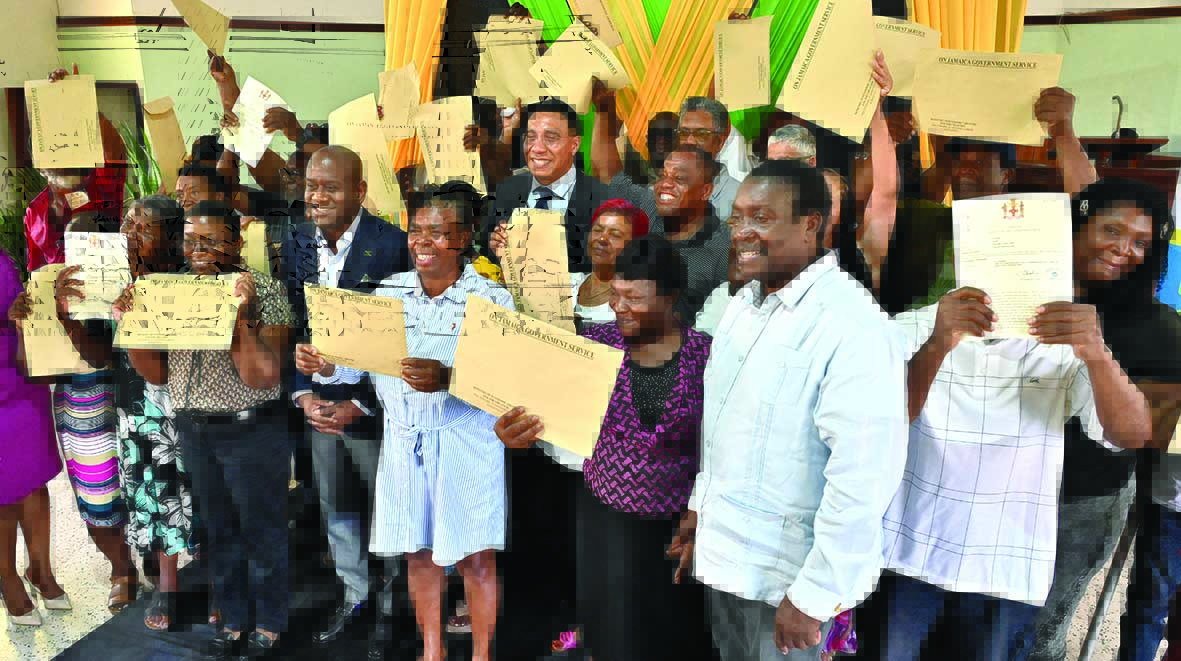
Prime Minister Dr Andrew Holness (centre); Duane Smith (third left), member of parliament for St Andrew North Western; and Robert Montague, (third right), minister without portfolio in the Ministry of Economic Growth and Infrastructure Development, pose with the resident of Ackee Walk and Jackson Town after presenting land titles to them at the Meadowbrook Church of Christ in St Andrew on Thursday. Photos by Rudolph Brown/Photographer
-
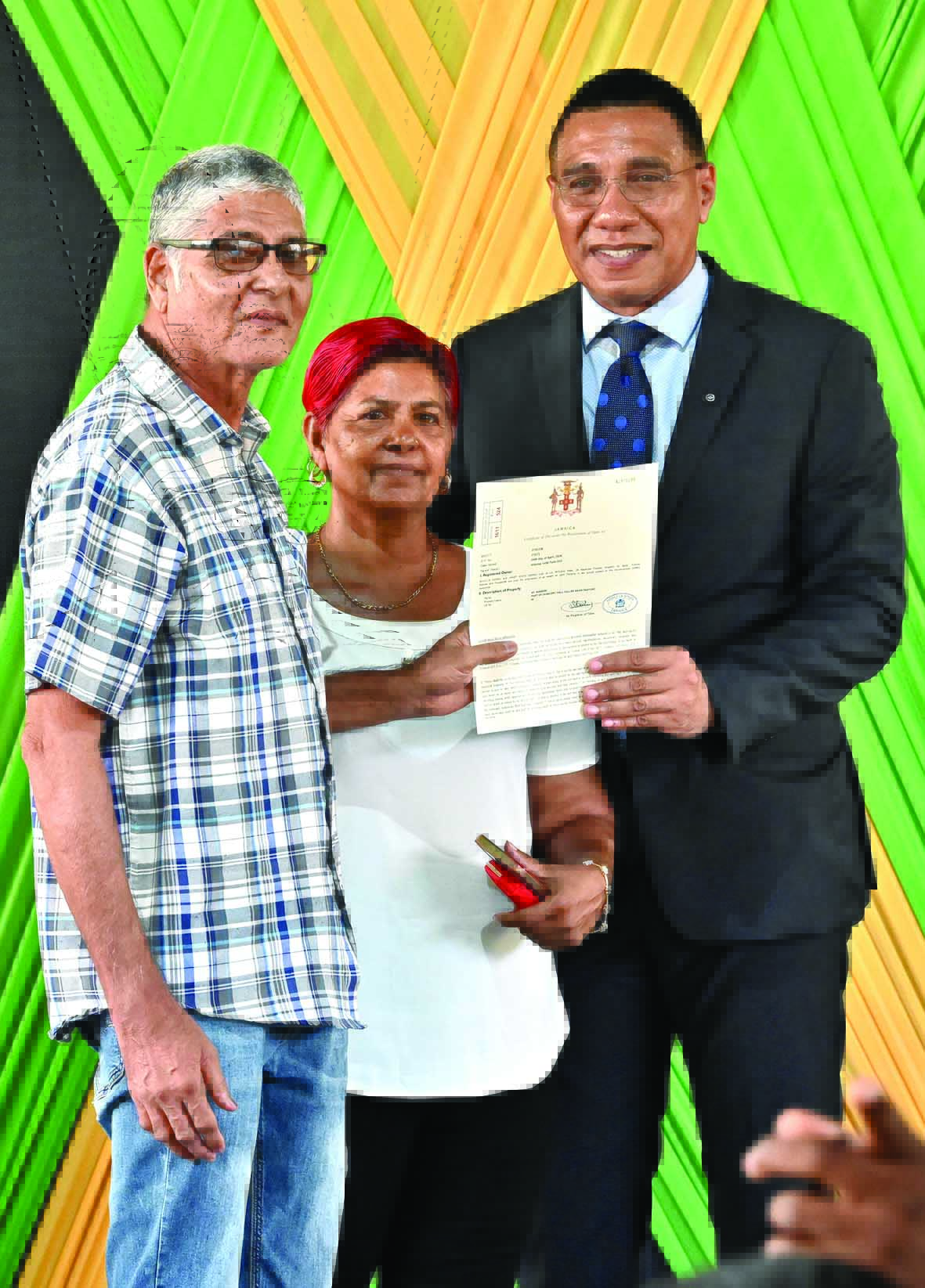
Prime Minister Dr Andrew Holness (right) presents land titles to Basillis Nehru and his wife Janet Nehru during the ceremony yesterday.
Prime Minister Dr Andrew Holness has argued that expanding land ownership and accelerating the titling of informal settlements are critical to Jamaica’s economic development, while describing property ownership as one of the most effective ways to break intergenerational poverty.
Holness was speaking on Thursday at a land title distribution ceremony, where 40 residents from the communities of Ackee Walk and Jackson Town in St Andrew received registered titles to the properties they occupy.
The beneficiaries comprised 10 residents from Ackee Walk and 30 from Jackson Town.
Addressing the recipients, Holness said the occasion was about more than the distribution of land titles, describing it as an effort to secure dignity, strengthen property rights, and address a long-standing challenge of informal land settlement across Jamaica.
“A title gives confidence,” Holness said, noting that ownership provides legal certainty and creates opportunities for families to transfer assets to future generations.
He argued that ownership of land or property is one of the pathways through which families can build wealth and escape cycles of poverty, adding that the Government is seeking to create an economy where every Jamaican has the opportunity to legally acquire property.
The prime minister acknowledged that the issue of informal settlements has existed for decades and has challenged successive administrations.
He said the Government is assisting persons who are in a position to formalise ownership and is pursuing measures aimed at regularising communities that have developed outside the formal land registration system.
Holness noted that in October 2024, the Government established the legal framework necessary to advance the regularisation process in Ackee Walk and Jackson Town, describing the exercise as lengthy and complex.
“It is the intention of the Government to declare more lands,” he said, while stressing that development requires balancing social needs with property rights and orderly land use.
He also linked land titling to economic growth, pointing to what he described as a relationship between countries with high levels of registered land ownership and stronger economic performance.
He argued that formal ownership encourages citizens to invest in, maintain and protect their communities while creating assets that can be leveraged for economic advancement.
Holness also used the occasion to reiterate the Government’s position against unlawful occupation of land, saying Jamaica can no longer rely on informal and illegal settlement patterns if it is to achieve sustainable development.
He noted that unplanned occupation can limit future housing projects, infrastructure development and other public investments.
Minister without Portfolio in the Ministry of Economic Growth and Infrastructure Development with responsibility for Land Titling and settlement, Robert Montague, similarly emphasised the importance of legal ownership, telling recipients that the titles represented more than a piece of paper.
According to Montague, the documents provide security, hope and a foundation upon which families can build their future.
He also urged citizens to work with the Government through established channels rather than engage in squatting or attempts to unlawfully acquire land.
Member of parliament for St Andrew North Western, Duane Smith, described the titling exercise as the culmination of years of work spanning multiple political representatives.
Smith said the process began under his father, former Member of Parliament Derrick Smith, continued during the tenure of Nigel Clarke and was completed under his stewardship.
Describing the effort as a relay race, Smith said “the baton was never dropped” as successive representatives worked to bring the process to completion.
He noted that while the Ackee Walk regularisation process proved relatively straightforward, Jackson Town presented greater challenges.
Speaking on behalf of the beneficiaries, one recipient described the occasion as the fulfillment of a long held dream, saying the titles would provide security, pride and peace of mind for families.
She said the documents represented more than legal ownership, describing them as a foundation upon which families can build, invest and create opportunities for future generations.