Aiken: No Jamaican man needs to die from prostate cancer
Loading article...
-
 Professor William Aiken. Photo - Contributed
-
Professor William Aiken. Photo - Contributed
-
 Patrons at the Guardian Life Blue Run 5K, the aim of which was to increase public awareness of the high incidence of prostate cancer in Jamaica and showcase how best to raise awareness within families and communities about the disease. The event took place at Emancipation Park in New Kingston on September 20. Photo - Rudolph Brown/Photographer
-

-
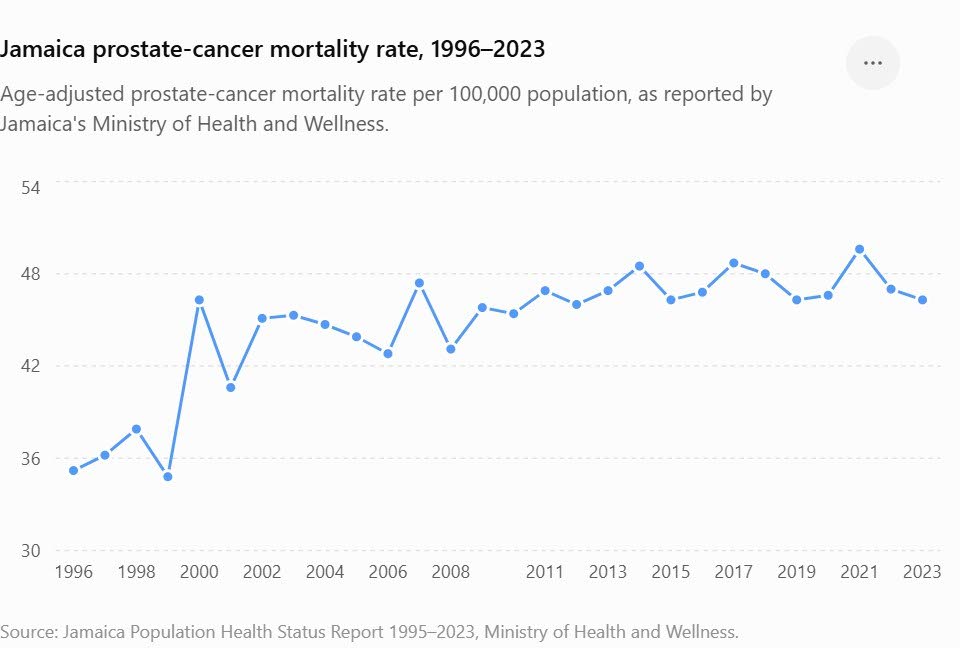 Photo - AG Guest Guest
One of the most dangerous things about prostate cancer is how quietly it can begin. A man can feel well, move through his days without alarm and have little reason to suspect that anything is wrong. Yet, according to Professor William Aiken, that quiet period is precisely when medicine may have its greatest advantage.
By the time symptoms give him a reason to worry, that advantage may already be slipping away.
After more than three decades in urology, treating Jamaican men at the University Hospital of the West Indies and devoting years to prostate cancer treatment, Aiken has seen both ends of the disease: men whose cancers are discovered while cure remains possible, and those who arrive only after it has advanced beyond that window.
A consultant urologist, Aiken is professor and head of the Department of Surgery, Radiology, Anaesthesia and Intensive Care and Emergency Medicine at The University of the West Indies, Mona. He began his career at the University Hospital in 1991 as a surgical resident and later became the first graduate of The UWI’s Doctor of Medicine (DM) programme in Urology. His specialist training included a year in Edinburgh, Scotland, on a Commonwealth Scholarship before he returned to Jamaica and continued a career spanning clinical practice, teaching and public education.
Since 1995, he has also volunteered in prostate cancer screening through the Jamaica Cancer Society, giving him a front-row view of changing public awareness, persistent misconceptions and, perhaps most critically, the consequences of men arriving for care too late.
It is from that vantage point that he makes one of his strongest assertions about the disease.
Aiken does not hedge the statement.
“No Jamaican man needs to die from prostate cancer,” he said.
At the centre of that conviction is early detection.
“Early prostate cancer generally does not cause any symptoms,” he explained. “Early prostate cancer is when it can be cured if it is discovered at that stage.”
It is the paradox at the heart of his message for Prostate Cancer Awareness Month, which concluded yesterday. The absence of symptoms, so often taken as reassurance, can create a false sense of security while the disease progresses undetected.
For Aiken, the conversation cannot begin only when something feels wrong. It has to begin while a man still feels perfectly well.
One misconception he has repeatedly encountered is the belief that prostate cancer is primarily something to worry about when it runs in the family. Family history matters, but its absence should never be mistaken for protection.
Aiken said approximately 90 per cent of newly diagnosed cases occur in men with no known family history of the disease.
“Not having a family history of prostate cancer does not protect you against developing prostate cancer,” he said.
For Jamaican men, there is another factor that cannot be ignored. Men of African ancestry are at increased risk of developing prostate cancer, while advancing age further raises that risk.
Aiken places the issue within a wider health challenge extending beyond Jamaica to the Caribbean and African diaspora.
He recommends that men begin screening at age 40 and continue annually, using both the prostate-specific antigen blood test, more commonly known as the PSA, and the digital rectal examination. For generations of men, the latter has acquired a reputation large enough to become a punchline, an embarrassment or, for some, sufficient reason to avoid the doctor altogether.
Aiken is unsentimental about that discomfort. The two tests are complementary, and relying on one while avoiding the other can leave room for disease to be missed.
He recalled a prostate cancer survivor whose PSA result had been perfectly normal. What raised the suspicion of cancer was an abnormal nodule detected during examination of the prostate. Without the DRE, Aiken warned, there is a risk that some cancers could be missed.
The PSA and DRE are screening tools, not a diagnosis. An abnormal result may lead to further investigation, including imaging and a biopsy to determine whether cancer is actually present.
That distinction can easily become lost amid the fear surrounding cancer screening. Getting screened does not mean a man has cancer. An abnormal result does not necessarily mean he has cancer. Even a prostate cancer diagnosis does not automatically mean his next stop is an operating theatre.
What screening does is give doctors information earlier.
For Aiken, that time matters enormously.
Cost can also influence whether men seek care. While acknowledging it as a barrier, Aiken credits the National Health Fund with improving access by subsidising PSA testing as well as prostate cancer treatment and costly medications.
Still, the patients he least wants to meet for the first time are those whose bodies have finally given them no choice but to seek help.
Some arrive unable to pass urine. Others present with bleeding. In advanced cases, prostate cancer can spread to the spine, affecting a man’s ability to walk.
“What we want to see are men who have absolutely no symptoms going to the Jamaica Cancer Society, going to their primary health care clinics, going to their GPs and being screened for prostate cancer,” Aiken said.
But feeling well is not the only reason men stay away.
For some, the fear is not necessarily of cancer itself. It is of what they believe may come after the diagnosis.
Stories about erectile dysfunction, urinary incontinence and the lasting effects of treatment can loom large enough that avoiding the doctor begins to feel like the safer choice. For a man worried about his sexual function, his independence or permanent changes to his body, screening can become associated not with prevention, but with the beginning of everything he fears losing.
Aiken has watched that fear produce what he describes as a “self-fulfilling prophecy”.
“A lot of men defer coming to the doctor because they’ve heard about these side effects of treatment,” he said.
But postponing screening does not stop the disease. If cancer is present and continues to progress, the delay can eventually reduce the treatment choices that may have offered the best chance of preserving quality of life.
“When they postpone screening, they lose the opportunity for us to detect the disease when it’s early,” he said.
The outcome is almost painfully circular. A man avoids screening because he fears losing his erections, his continence or his quality of life, only to present later with disease that makes those very outcomes more difficult to prevent.
Had the cancer been detected sooner, Aiken said, the picture might have looked very different.
“In all likelihood we would have been able to preserve their erections, preserve their continence, give them a good quality of life in treatment,” he said.
That distinction matters because prostate cancer treatment is not a single, inevitable path.
The word “cancer” can collapse every possibility into the same frightening picture: major surgery, radiation, aggressive treatment and permanent changes to life as a man knows it. The reality, Aiken explains, can be considerably more nuanced.
Treatment depends on the patient, the characteristics of the cancer, his life expectancy, his preferences and the likelihood that the disease will progress. Some cancers require intervention. Others, particularly some lower-risk cancers, can be followed through active surveillance, with doctors closely monitoring PSA levels, examinations, imaging and other indicators before deciding whether treatment is necessary.
Active surveillance is not about ignoring cancer. It allows doctors to respond to the disease in front of them without unnecessarily subjecting a patient to treatment and its potential side effects before there is evidence that intervention is required.
For the man sitting at home avoiding screening because he assumes any diagnosis will immediately lead to life-altering treatment, that distinction is significant. Finding prostate cancer early can improve the possibility of cure while also preserving something that fear can make easy to overlook: choices.
After more than 30 years watching Jamaican men confront the disease, Aiken’s message this Prostate Cancer Awareness Month is therefore less about waiting for warning signs than refusing to make them the starting point.
The man who feels perfectly well may believe there is no urgency.
Aiken’s argument is that this is precisely when screening matters most.
PROSTATE CANCER FACTS
. Prostate cancer is Jamaica’s most frequently diagnosed cancer. In the 2022 GLOBOCAN estimates, there were 1,599 cases, representing 21.3 per cent of all cancer cases in the population and 43.1 per cent of cancers diagnosed among men.
. The disease is also the leading cause of cancer death among Jamaican men. In 2023, 716 men died, rising to 809 in 2024.
The 2024 figure of 809 deaths works out to roughly 2.2 deaths per day.
. Jamaica’s Ministry of Health says prostate cancer is the most frequent cancer in Jamaica and is associated with the most cancer deaths. Its current guidance says screening should begin at age 40.