Montel Gordon | Belfast riots: Are the same scripts being revived?
Loading article...

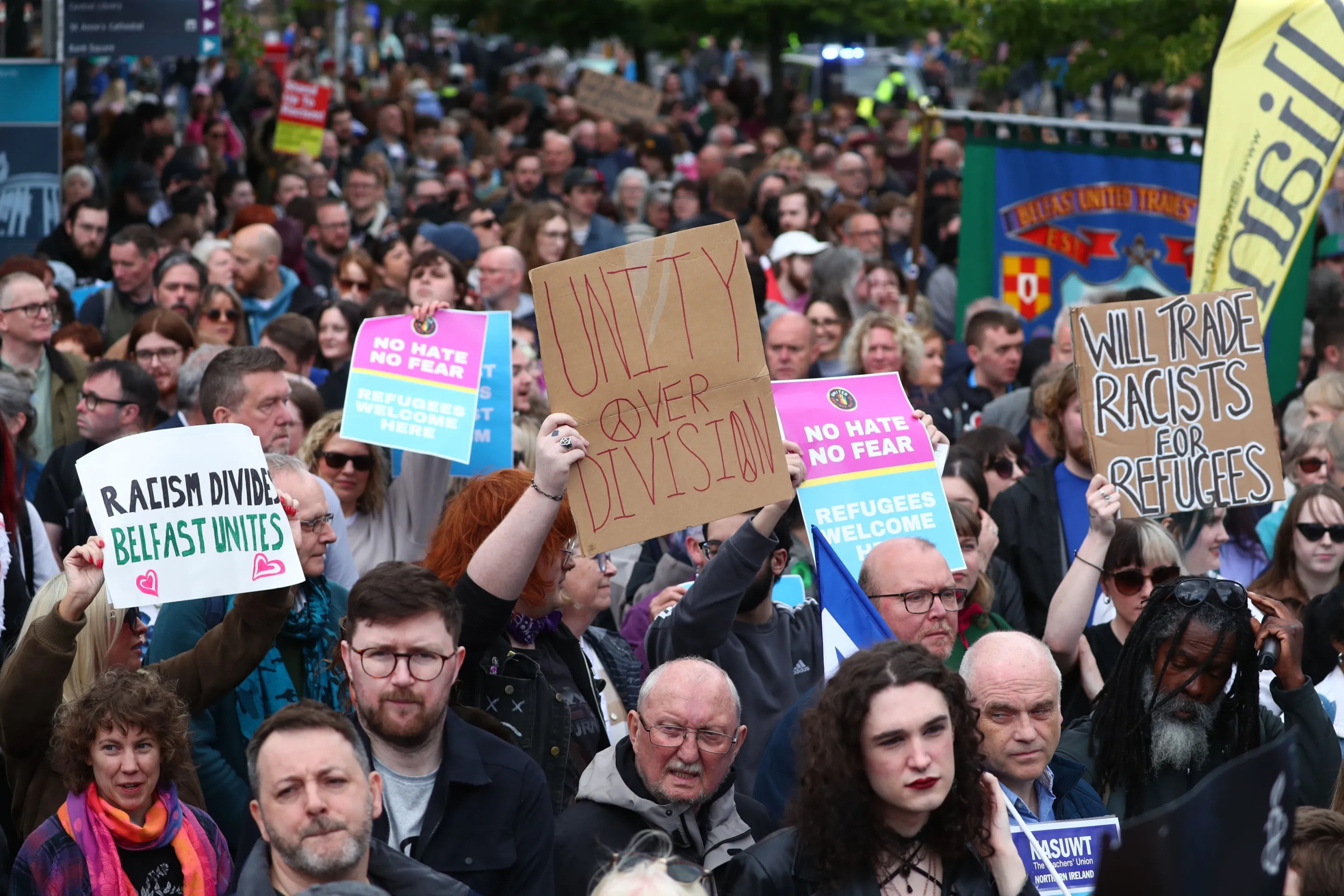
.The year 2016 will always be remembered as a watershed moment in the West. Brexit and Trump’s election signified a widespread shift toward right-wing populism
The manufactured anxieties of immigration have not just been orchestrated in the UK through the seismic rise of Reform UK, but interestingly throughout Europe, with nations such as Italy, Hungary, France, and Germany, to name a few, all constructing narratives of minority groups as an ‘enemy within’.
The riots last week in Northern Ireland sang from the hymn sheet of the Southport riots just shy of two years prior, with anti-migrant rhetoric fuelling violence. This mobilisation of the far-right is architected through turning minority groups into the ‘problem’. Distinctively, this draws parallels to the ‘Troubles’, where the British state positioned Catholic and nationalist communities as ‘dangerous’, justifying harsher surveillance and policing. The same internal enemy logic we see is being extended to black and minority communities in Northern Ireland.
Ireland is Britain’s oldest ‘colony’ and, foremost, the test dummy for British colonial and imperial rule that ravaged its way through a quarter of the globe. Evidently, the mechanisms of mass surveillance, excessive use of police powers, and intelligence and media propaganda became tools to demonise the ‘other’ – cast as an ‘enemy within’.
‘The Troubles’ – emerging from the strife of Irish self-determination during the 1960s until the Good Friday Agreement in 1998. The British state and loyalist groups would often react to violence by collectively blaming entire communities. The stabbing regurgitates a familiar mantra of scapegoating and fear against the ‘other’, where this time, minority groups and migrants were the targets and became the trigger to fit the curated narrative that migrants are dangerous. Here, the political use of fear is used to entice racial hostility and violence.
With the rise of social media and more informal means of gaining news – for example, platforms such as X, renowned for spreading and enticing racial hostility - it’s helped galvanise violence towards minority groups. US President Donald Trump, Elon Musk and Tommy Robinson, throughout the years, have used their platform to call upon the mobilisation of the far right to retaliate.
In this case, people took to the streets, burning houses and vehicles and blocking roads.
Northern Ireland’s first minister, Michelle O’Neil, vehemently condemned the attacks as “racist thuggery”. The proliferation of fascism and racism is also notable, with 1,517 racist hate crimes recorded in the past year, the Police Service of Northern Ireland, which is their highest to date. But interestingly, this is the third summer of unrest in Northern Ireland. In 2024, following the Southport attack, and in 2025, when two Roma men were accused of sexually assaulting a young woman, many took to the streets to voice themselves, alas, in many cases violently.
At the root of most of these issues lies deep economic deprivation faced by historically working-class communities, where anger is now redirected towards migrants. In many Protestant communities, unemployment, poverty, and political discrimination persist, and anger that was once directed towards Catholics is now directed towards migrants and racialised minority communities.
Research by Poverty and Social Exclusion (PSE), a consortium of several universities including the University of Bristol, Queen’s University Belfast, and the University of Glasgow, reported that 36 per cent of households cannot afford three or more basic necessities, with Northern Ireland having higher levels of deprivation than the rest of the UK, and over a third of the population living on or near the breadline.
The research organisation Equality Trust also identifies economic disparities and their link to the far right, which remains a common trend across most European nations. Additionally, even stretching back into the 1970s and 1980s with the rise of the National Front, and into the 2000s with the emergence of the British National Party and the English Defence League, all played into economic insecurities and manipulated the masses.
This is an experience comparable to that of black communities, especially in England, with a long-standing history of turning racialised groups into ‘problems’. From the 1950s onwards, black communities have suffered from the usage of ‘sus laws’, extension of police powers, stop and search and the ‘hostile environment’ regime. Therefore, we know that violence does not simply emerge in a vacuum; rather, it is cultivated. ‘The Troubles’ showed how Britain cultivates fear, and the riots showed how this becomes targeted.
The narrative that propelled moral panics is a remnant of the past being perpetuated today.
Many of these sentiments sit within the realm and hangover of British colonialism and the legacies of the ‘Troubles’. The violence witnessed following the stabbing in Belfast is a reaction to the political culture of the “enemy within”, which has been constructed and needed to justify means of othering.
What right-wing populism has done is simply replace Catholics with migrant and black communities – we are seeing the same script being replayed right in front of our eyes.
Montel Gordon is a James McCune Smith PhD scholar at the University of Glasgow researching race and education. He is also a freelance journalist. Send feedback to columns@gleanerjm.com