Mickel Jackson | When Parliament sentences instead of the judge
Loading article...
-
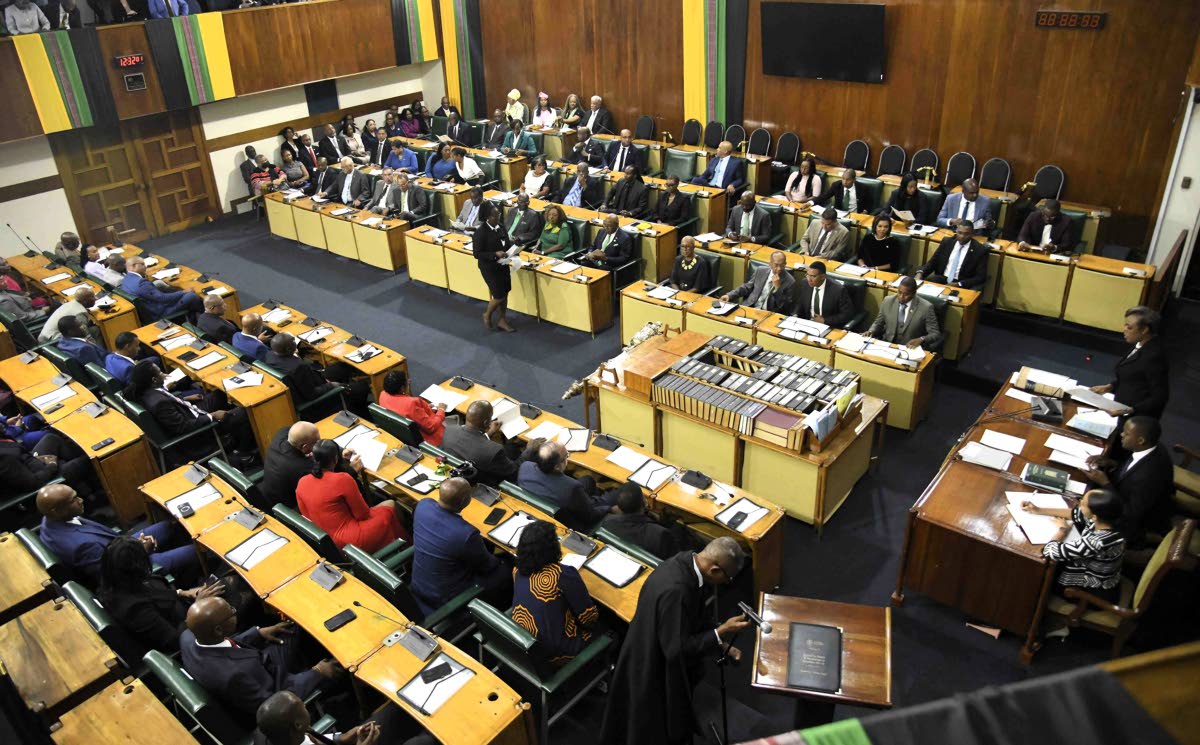 Members of Parliament before at the swearing-in ceremony for members of the upper and lower houses of Parliament held on September 18, 2025 in Gordon House.
-
 Mickel Jackson, Executive Director of Jamaicans for Justice
Illegal firearms remain the principal instrument of murder, robbery and intimidation. That is not in dispute. What is in dispute is whether a 15-year mandatory minimum, applied indiscriminately to possession of a prohibited weapon, including an imitation firearm that cannot fire a round, is a just or even effective way to confront that violence.
Jamaicans for Justice is not opposed to mandatory minimum sentences in principle. We have said so repeatedly. We are opposed to sentences that are manifestly excessive, that erase judicial discretion, and that treat every accused person as if they were the same. When Parliament ties the hands of the courts so tightly that a judge who has heard the evidence cannot impose a proportionate sentence, the separation of powers is undermined and grave injustices will occur.
The Firearms (Prohibition, Restriction and Regulation) Act, 2022 was sold as the State’s most uncompromising answer to illicit guns. Possession of a prohibited weapon under Section 5 attracts imprisonment of not less than 15 years and a maximum of 25 years. Imitation firearms were swept into the same net. An earlier form of the bill contemplated mandatory life for possession of the item, not for its use to cause harm. The floor for mere possession is high enough that the statute barely distinguishes holding the item from using it. That is a legislative blunder.
A music producer with a single imitation firearm, without the required authorisation, would face the mandatory minimum of 15 years. If he has three or more imitation firearms on set, he could be charged with stockpiling under Section 6, which carries mandatory life imprisonment, and the court must fix not less than 20 years before parole. There is no distinction from someone stockpiling illegal weapons for criminal use.
The act also creates unauthorised possession of a firearm or ammunition held without the appropriate authorisation. On conviction in the Circuit Court, the penalty is life imprisonment, with a pre-parole term of not less than 15 years. That regulatory offence is capable of being harsher than Section 5. The inversion is an anomaly that should be corrected without raising the Section 5 minimum.
Plea bargaining is an important feature in the administration of justice. An accused person who saves the court’s time and spares the victim expects a meaningful benefit in return. A guilty plea is widely treated as leaving the 15-year minimum in place. Chief Justice Bryan Sykes has warned that mandatory minima can remove the incentive to plead guilty. If the sentence is the same either way, he asked, what does it matter whether the accused pleads or goes to trial? The rational course is therefore trial.
FOLLOW LOGIC
The court data follow the logic. Conviction and guilty-plea rates in the High Court Division have declined. Gun Court matters pile up again after earlier gains against backlog. Victims of other crimes wait because courtroom time is consumed by trials that a functioning sentencing regime would have resolved.
Section 42K of the Criminal Justice (Administration) Act is the supposed safety valve. Where a defendant has been tried and convicted, and the court finds the prescribed minimum is manifestly excessive and unjust, the court must still impose it, then certify the case so the Court of Appeal may go below the minimum. However, the trial judge who has heard the evidence should be able to depart from that minimum where the interests of justice require it.
The government points to falling murders and argues that the act is “working”. Murders have fallen, and that is a relief every Jamaican should welcome. Attribution is another matter. Homicide fell after intelligence-led policing, gang disruption, border interdiction and seizures, reasons that cannot be reduced to one sentencing clause. Attorney Peter Champagnie is right to insist on evidence rather than assertion.
NECESSARY REFORMS
Reform does not require the State to relent on operational firearms. Parliament must restore to sentencing judges the power to depart from the mandatory minimum where the interests of justice require it, and keep severe penalties for trafficking, use in violence, and the illicit guns that arm criminal networks. Judicial discretion is not softness.
Separate imitation firearms from real prohibited weapons in definition and penalty. If film, theatre and recreation need tighter safeguards, write them. Section 62 is sometimes cited as if it revived the old stage-and-screen carve-out. It does not. It authorises an actual firearm or ammunition on a theatrical, film or television set. An imitation used as a prop is not a firearm. That gap remains.
The review must deal with children. In NF v R, the Court of Appeal set out the anomaly. A child under 14 tried in the Children’s Court faces detention of up to 25 years pursuant to the Child Care and Protection Act (CCPA). A child tried jointly may be dealt with only under Children’s Court powers. A child of 14 or over charged alone with a firearm offence is meant to be remitted under Section 8 of the Gun Court Act, but the Children’s Court cannot try the firearm offence, so the case returns to the Gun Court and the prescribed minimum can apply. Section 75 of the CCPA allows remittal to Children’s Court for sentence after conviction, but only if the Court sees fit. Those are three different sentencing schemes for the same class of offence. The Court of Appeal said only Parliament could correct that. The Firearms Act 2022 did not. The revision has to fix the difference in powers, not leave a child’s sentence to the form of the charge.
None of this requires Jamaica to “go soft on guns”. Illegal firearms should be seized. Traffickers should be prosecuted. People who shoot other people should face appropriate and certain punishment. The public is safer when the system distinguishes the armourer from the ill-advised, the shooter from the prop user, the repeat offender from the first-time possessor who can still be diverted.
There is no public safety without a functioning justice system, and there is no functioning justice system when Parliament sentences in place of the judge. Restore to the courts the capacity to look at a human being and the facts of the case.
Mickel Jackson is the executive director of Jamaicans for Justice. Send feedback to communications@jamaicansforjustice.org.