PM tells regional countries, ‘who vex loss’
Loading article...
-
 Trinidad and Tobago’s Prime Minister Kamla Persad Bissessar.
-
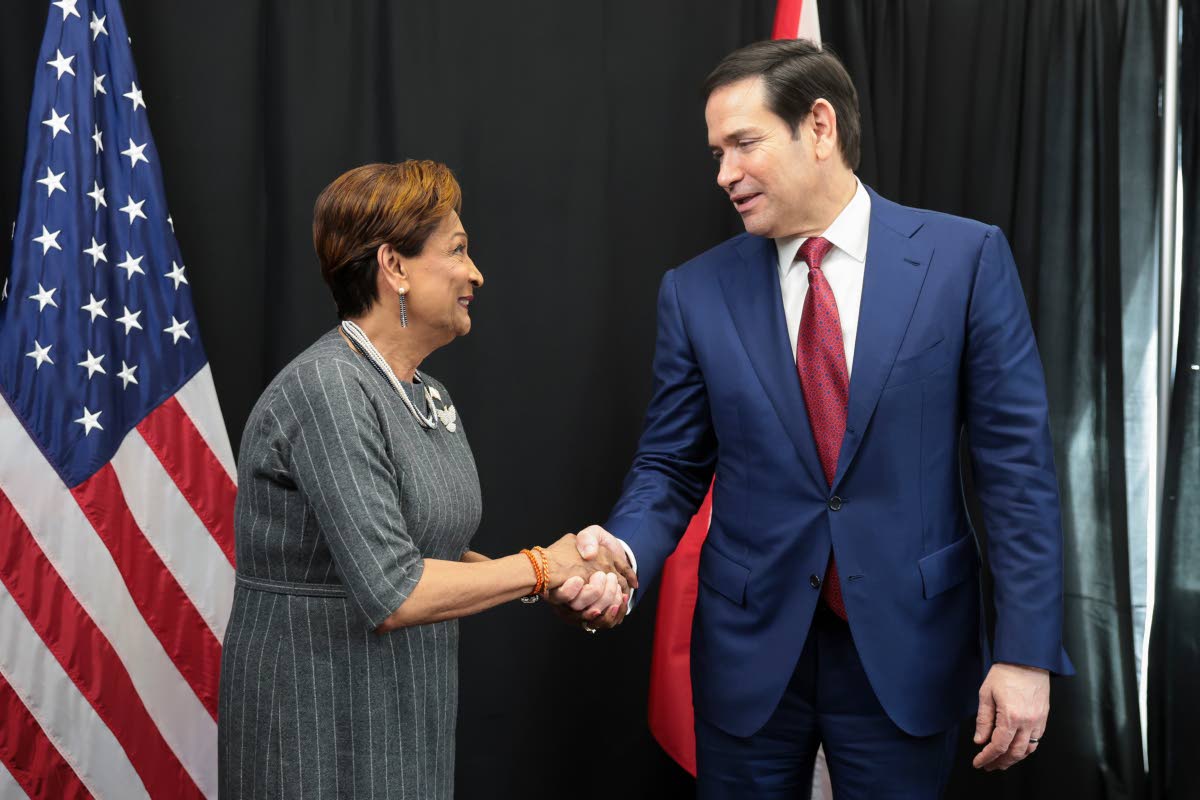 United States Secretary of State Marco Rubio meets with Trinidad and Tobago Prime Minister Kamla Persad-Bissessar during the Caribbean Community (CARICOM) meeting in Basseterre, St Kitts and Nevis yesterday.
BASSETERRE, St Kitts (CMC ):
Trinidad and Tobago’s Prime Minister told regional leaders on Tuesday “who vex loss” as she reiterated her full support for the United States military presence in the Caribbean in helping to deal with the illegal drug trade, while also criticising the existing political situation in Cuba.
Addressing the ceremonial opening of the 50th ordinary meeting of the Caribbean Community (CARICOM), Persad-Bissessar took yet another turn at the regional integration movement for its adherence to the Caribbean being declared a zone of peace.
She said the decision by Washington to send its military into the Caribbean Sea to help stem the flow of illegal drugs to the North American country had paid dividends for her Caribbean island as she linked the high murder toll in the oil-rich twin island republic to the drug trade.
“So again, I repeat…who vex loss. But we gained. We gained from the …military help, and I will welcome them again. So we changed the policy, and we were able to bring those murders down by 42 per cent, as I say, that’s 257 less people who would have been dead had we not taken that course of action,” she told the ceremony. Watch video
Insisting that her administration is supportive of the 15-member CARICOM grouping, Persad-Bissessar sought to recall instances that questioned the sincerity of the grouping.
RESPECT
“We respect the sovereign right of CARICOM members, with respect to your choice for national security, for your nation, and respect to your choice for foreign policy…and we expect no less from others.”
She said Trinidad and Tobago “took very careful note” of what happened in CARICOM in 2025 when her government chose to lend support then to the Nicolás Maduro regime in Venezuela, and despite repeated threats against two fellow CARICOM members from Venezuela, most of the regional countries stood against the two.
She said that she had “openly” indicated that in the ongoing border dispute between Guyana and Venezuela, she had indicated that “if they touch Guyana, Trinidad Tobago, will be there with you and stand with you”.
She said Trinidad Tobago was threatened, “and we are still threatened by Venezuela,” adding “so how could a CARICOM come be a zone of peace when a narco-dictator who imprisoned and killed thousands of civilians and opposition members” because of politics.
“So how can it be when that regime was threatening violence to two CARICOM member states, there was no voice from the CARICOM. We were talking about a zone of peace. And in my respectful view, my country is not a zone of peace, and I’ll tell you why, because of the unreliability of the CARICOM in the above situation … we cannot bind ourselves to the same political ideologies, the same foreign issues and the same security policies…”