Communist party approves emergency economic plan
Loading article...
-
-
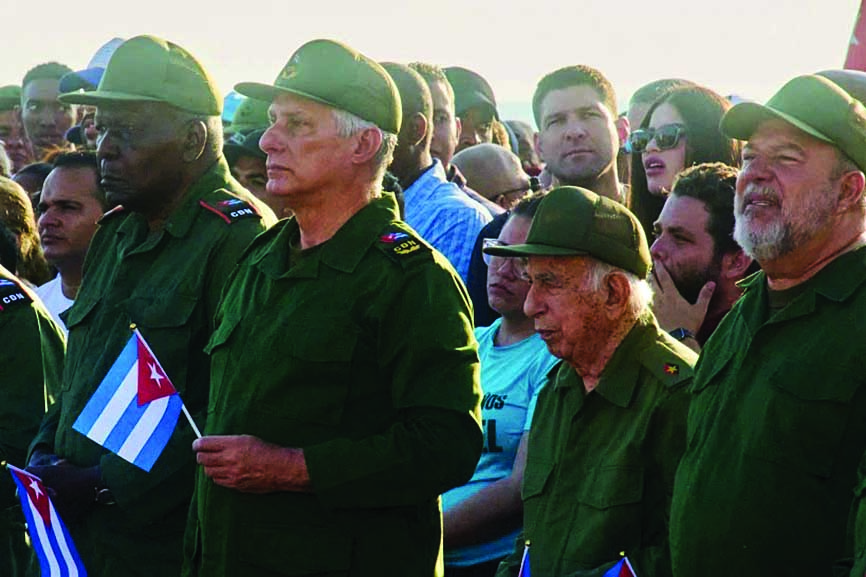
Cuba’s President Miguel Diaz-Canel (second left) and Raul Castro’s grandson, Raul Guillermo Rodriguez Castro (centre back), take part in a rally in support of former President Raul Castro in front of the US Embassy in Havana, Cuba, Friday, May 22, after US prosecutors filed an indictment accusing him of ordering the 1996 shootdown of civilian planes flown by Miami-based exiles.
Cuba’s powerful Communist Party yesterday approved an emergency economic package featuring unprecedented free-market measures aimed at opening up the struggling island’s economy as pressure from the US and the European Union heightens.
The document, which has not yet been made public, will be submitted to Cuba’s National Assembly. It envisions expanding opportunities for private enterprise, greater autonomy for municipalities and state-owned companies and measures to attract additional foreign investment, including from Cubans abroad.
In recent days, residents in several Havana neighbourhoods staged protests, banging pots and pans as power outages spread across the island.
“Cuba resists heroically and creatively, but has endured for too long a barbaric, undeserved and unbearable punishment, to which is now added the threat of military aggression,” President Miguel Díaz-Canel said late Wednesday in the closing speech of the Communist Party session. The speech was published yesterday.
The announcement comes after months of increasing pressure from the US and high-level talks between the two countries that have included Raúl Castro’s grandson, Raúl Guillermo Rodríguez Castro. The US has levied numerous sanctions against Cuba and has indicted Raúl Castro in connection with the 1996 downing of two civilian planes operated by Miami exiles.
Pressure from the European Union also ratcheted up yesterday, with lawmakers passing a resolution condemning “the systematic repression” by the Cuban government and demanding “profound economic and political change.”
The resolution also called for EU sanctions targeting Díaz-Canel and the leadership of Grupo de Administración Empresarial S.A. (GAESA), a business conglomerate operated by the Cuban Revolutionary Armed Forces. Both have already been sanctioned by the US.
Díaz-Canel said the emergency plan and the policy document prepared by the Communist Party’s Central Committee were shaped by the experiences of China and Vietnam, two communist countries that have introduced market-oriented economic reforms while maintaining one-party rule.
The document will be submitted to the National Assembly for debate during a special session that, like the recent party meeting, was convened without prior public notice.
Please create a fact box with text below
Key features of the reform proposals
- Decentralise state-run economy
Under the island’s current economic model, the government largely determines what is produced, who produces it, the prices at which goods are sold and how the country’s resources are allocated.
- Non-specific changes to foreign exchange market
Currently, only state agencies and banks can exchange currencies, though many people rely on the informal market.
- Government downsizing
Legislation has been introduced to reduce the number of ministries from 27 to 21 for greater efficiency.
- Municipal independence
Municipalities would gain greater authority to approve businesses in their jurisdictions and manage relations with economic actors, including state enterprises, co-operatives and private firms. They would also be allowed to import and export goods and control their own foreign-currency revenue.
- Autonomy for state-owned companies
Companies would be allowed to design their own pay systems, use and distribute profits with fewer restrictions, import and export goods, and partner with private firms and co-operatives.
Under the proposed changes, businesses, including small and medium-sized enterprises, would be allowed to import and export goods directly rather than through state-run entities that currently oversee the process and set fees. The measures also would provide incentives for the import of inputs and raw materials used in production.
- Subsidies to phase out
Cuba’s post-revolution rationing system long guaranteed access to basic products at low, controlled prices. However, upcoming reforms will gradually phase out these subsidies, moving food and other goods to market pricing.
- Rebuilding abandoned infrastructure
Recent US sanctions against Cuba’s business conglomerate Gaesa have forced historic hotel chains like Meliá and Iberostar to suspend contracts with their Cuban counterparts. New measures include finding new ways to utilise the island’s nearly abandoned infrastructure.
-AP
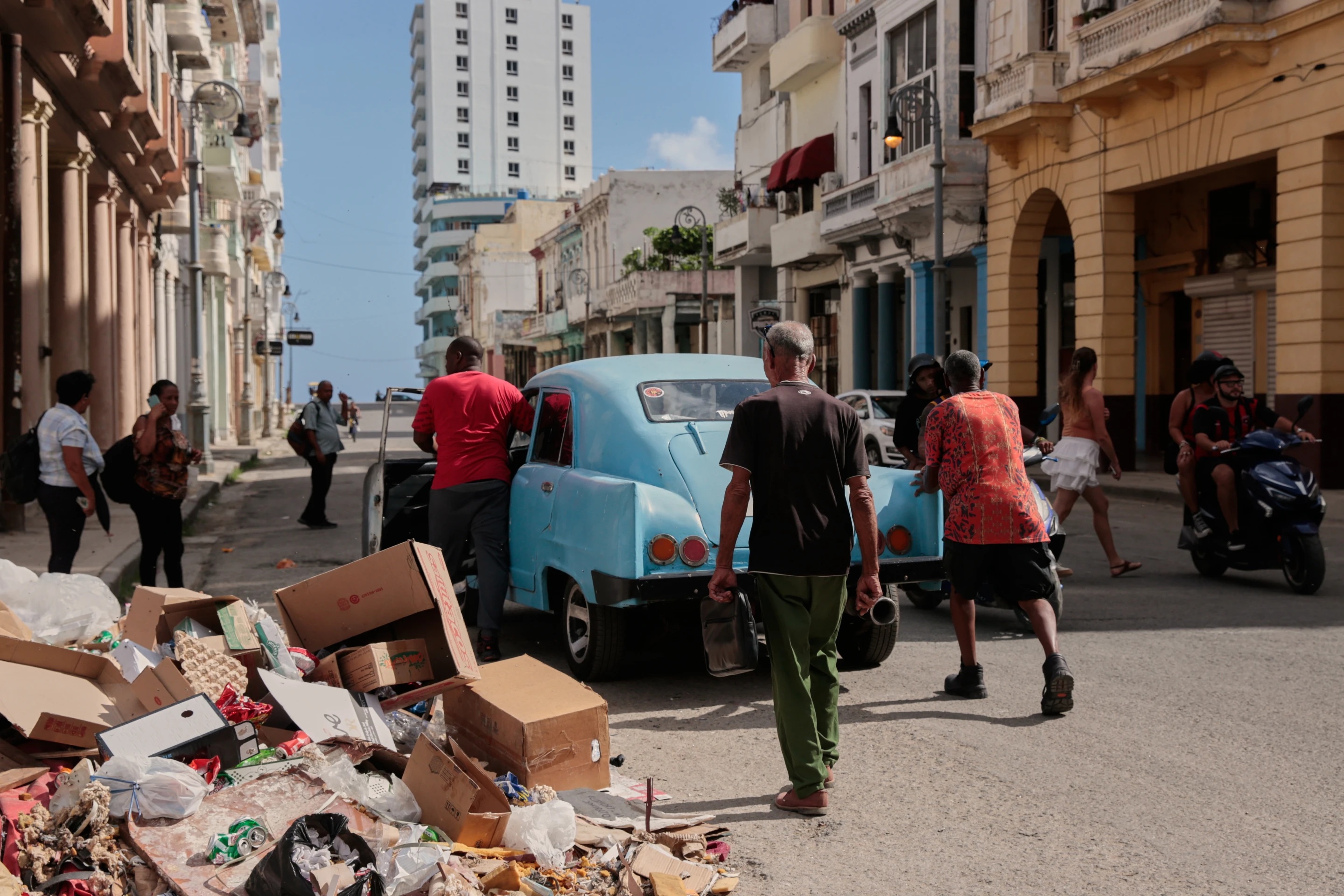
File name: cuba car
Caption: People push a broken-down, classic American car past a pile of garbage in Havana, Cuba on Wednesday. AP photos
File name: communist party
Caption: Cuba’s President Miguel Diaz-Canel (second left) and Raul Castro’s grandson, Raul Guillermo Rodriguez Castro (centre back), take part in a rally in support of former President Raul Castro in front of the US Embassy in Havana, Cuba, Friday, May 22, after US prosecutors filed an indictment accusing him of ordering the 1996 shootdown of civilian planes flown by Miami-based exiles.