Byron Blake | Whither the people of Cuba?
Loading article...
-
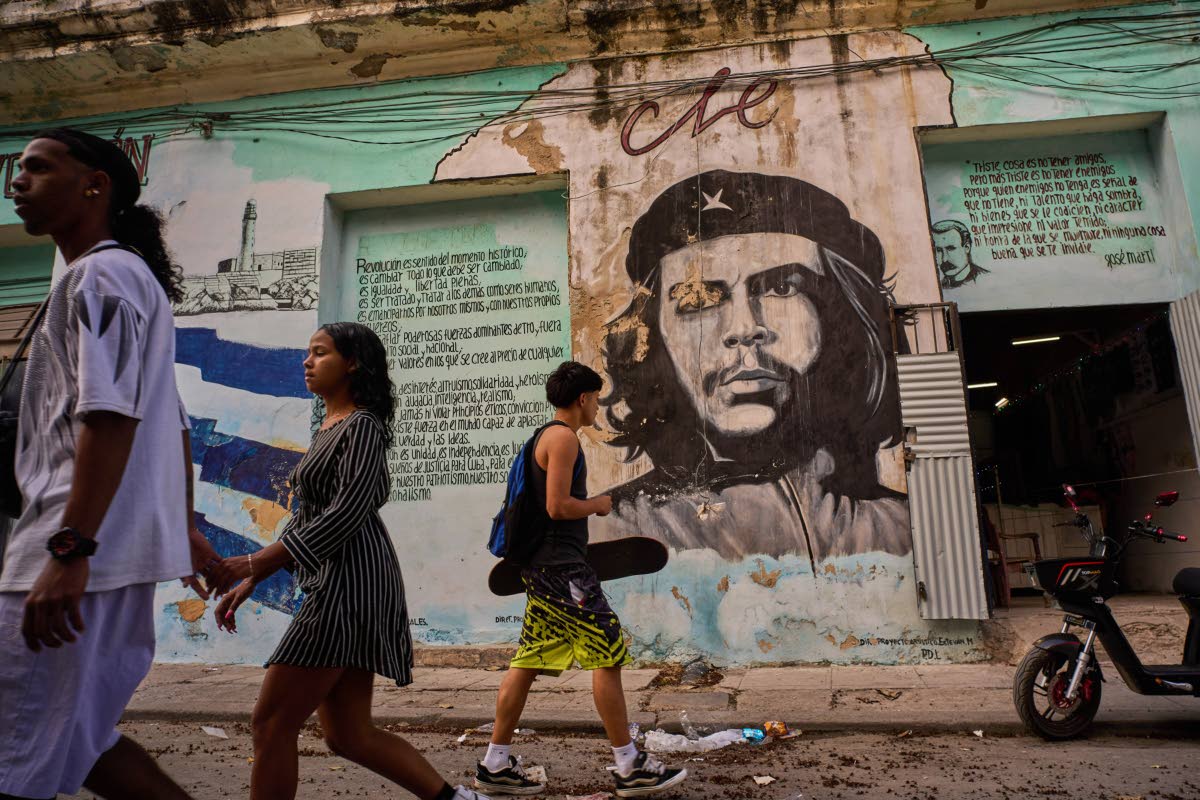 People walk past a mural of Che Guevara in Havana
-
 Ambassador Byron Blake
Cuba is the largest Caribbean island with a land mass of 42,426 square miles, and a population of 11.6 million in 2024. Life expectancy was 78.6 in 2025, with the female rate at 81 and the male at 76.3. This was up from 63.3 in 1960 and 67.9 in 1970.
Cuba had a per capita GDP of US$ 7,381.4 in 2024, marginally lower than the US$ 7,433.4 achieved in 2023. These economic and social achievements, despite a 66-year embargo by its largest natural market.
FIGHT FOR INDEPENDENCE
Cuba has a proud history. It fought three wars against the colonial power, Spain, before gaining its independence. The Little War (1879-1880), the Ten-Year War (1868-1878), and the War of Independence (1895-1898). Spain threw 220,285 soldiers in addition to 60,000 “irregulars” into the last war. The Cubans used superior tactical skills since they had little armoury to defeat them.
With a Cuban victory in clear sight, the United States decided to join the war. This was three months before the end. The Resolution that authorised the President to go to war specified that it was to (i) support Cuban independence, and (ii) disclaim any intention to annex Cuba. The Cubans facilitated the American Marines’ landing in Santiago on June 11, 1898.
The Cubans controlled Santiago. From there, the Cuban and the American forces were able, in the Battle of Guantánamo Bay from June 6 to June 14, 1898, to seize the strategically and commercially important harbour of Guantánamo Bay.
On December 10, 1898, the United States and Spain signed the Treaty of Paris, which formally recognised Cuban independence. But the United States (i) prevented Cuba from participating in the Paris peace talks and the signing of the treaty, and (ii) refused to allow Cuban General Calixto García and his forces to participate in the surrender ceremonies in Santiago de Cuba.
The arrangement left the United States and the white planter class, that did not join the fight, to control policies, the economy, and the administration. The Cuban people continued in the struggle until 1959.
When an ordinary, unnamed woman, writing in the spirit of women of that hardened and resilient community, says (i) call the energy blockade: “Crime Against Humanity” (ii) “Cuba is asking for Justice” (iii) “the blockade is programmed hunger”, and (iv) that incubators in Cuba have had to be shut down due to a lack of fuel”.
And, when eight former CARICOM leaders write “the Executive Order of January 29, by the United States against any nation providing oil to Cuba … constitutes economic warfare and inflicts unconscionable suffering upon the Cuban people.”
We are convinced that CARICOM Governments and people can no longer remain silent. Silence is complicity.
SELFLESS SUPPORT
I have been to Cuba numerous times between 1976 and 2000. I never felt afraid, even when jogging alone on the streets of Old Havana City or the extensive seawall, or in Santiago. I never saw a beggar. One morning in Santiago, when I burst into a sudden sprint and pulled a muscle, several persons sprang to my aid.
The Cubans are always among the first to respond to any natural disaster event in the region. I remember the massive 7.0 Earthquake that devastated Haiti in January 2010. Without fanfare, Cubans were among the first on the ground. They provided operational personnel with a range of expertise.
Cubans did not just respond to crises. Where appropriate, they provide more permanent solutions.
The Cuban response to the devastation of Hurricane Mitch in Nicaragua and Honduras, and Hurricane Georges in Haiti and the Dominican Republic in 1998 was twofold: (i) 2000 medical personnel to help provide short-term emergency relief, and (ii) the establishment of the Latin American Medical School to train 500 medical students per year, for ten years, for the four countries.
Nesha Haniff wrote in Stabroek News of February 18, “Gratitude is the Memory of the Heart”. That title, the brainchild of Jean-Baptiste Massieu (1772-1846), innovative teacher of the deaf, who was only accepted into the School for the deaf as a teenager, had much for which to be thankful. He responded in his work among the deaf community and others. Dr. Haniff’s message is that CARICOM Countries should show gratitude to Cuba. Indeed, they should.
That same message underpins the urgent appeal by The Global Afrikan Congress, through its ambassador Cikiah Thomas, to former prime ministers P.J. Patterson, Kenny Anthony, and Ralph Gonsalves to spearhead a CARICOM diplomatic mission to African oil-producing nations to secure emergency energy assistance for Cuba.
We respectfully suggest that in the instant situation of an illegal blockade that punishes over 11 million civilians – women, men, children; the aged, infants, and the unborn; not Governments or even Government officials, but civilians, action must come from another place. It must come from our core- a revulsion against injustice and our respect for human life and dignity.
WHAT CAN 14 SMALL STATES DO?
1. They have 14 voices and a moral issue. Use those 14 voices, often, loudly, and in unison. The clarion call should come out of the conference in St Kitts and Nevis next week.
2. They are members of several International Organisations, including
the United Nations and key Agencies like WHO and PAHO, and hemispheric Organisations like the OAS. This is not a membership issue; it is a moral issue, a humanitarian issue. Use those forums.
3. They have organising and mobilising capacity. The Global Afrikan Congress recognised this. Use that asset.
4. Internally, each State must raise the awareness of its citizens, especially the articulate and comfortable. This is not an issue of action against a communist government or a government that is oppressing its citizens. It is an act of terror against the population of another country.
Ambassador Byron Blake is former deputy permanent representative of Jamaica to the United Nations and former assistant secretary general of CARICOM. Send feedback to columns@gleanerjm.com.