
From Ewarton to the high altar
Unlikely journey of Father Marlon Myers
Published:Monday | February 2, 2026 | 12:07 AM
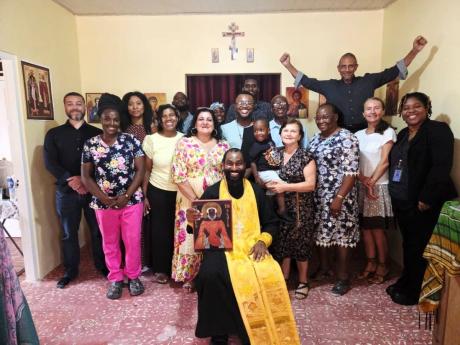

Marlon Marlondo Myers was born into church. Not the casual, once-a-week kind, but the deep, lived-in kind where faith shapes your mornings, your evenings, and your sense of who you are.
He grew up in Ewarton, St Catherine, the only son among four children, raised by parents who did not just attend church, but led it. His father, Raphel Myers, has been pastor of the Church of God of Prophecy on Roadside for more than 40 years and later became a bishop. His mother, Audrey, is a minister. His sisters were all active members. Church was not an option. It was life.
“There was always an expectation that I would become a pastor,” he said, laughing softly. “I was doing everything already.”
And he was choir director, youth leader, men’s director, Bible study teacher and Evangelism team leader. He also founded a youth-mentoring centre. If there was a role to fill, Marlon filled it. But even as he admired his father deeply, he knew he did not want to inherit the pulpit in the way everyone expected.
Instead, he followed another calling, helping people one-on-one. Today, he works with the Department of Correctional Services as a probation aftercare officer and registration officer for Jamaica’s Sex Offender Registry. He mediates. He counsels. He mentors young people through the HEART/NSTA Trust. “Seeing change in people’s lives,” he said, “that’s my reward.”
Yet, for all his service, something still felt missing.
He recalled that restlessness back to his teenage years. Prayer became more intense. Fasting more frequent. His desire to know God deeper, sharper. “No matter how close I thought I was,” he said, “I felt distant.”
After college, he worked briefly in tourism, then enrolled at Jamaica Theological Seminary, where he studied from 2000 to 2004. The motto there stuck with him: “That I May Know Him, That I Might Make Him Known.” He took it seriously. He even found himself admiring Pope John Paul II, drawn to the weight and symbolism of ancient Christianity, though Roman Catholicism never quite felt like home.
The turning point came quietly, on a laptop screen.
NEEDED TO FIND OUT
In March 2014, Marlon was watching an old YouTube video of Pope Francis’ inauguration when his attention wandered to an elderly, bearded figure standing nearby. The Ecumenical Patriarch of Constantinople. “I didn’t know who he was,” Marlon admittd. “But I knew I needed to find out.”
That curiosity opened a door he did not know existed. He began searching. Watching. Reading. Late nights led him to the Divine Liturgy of the Orthodox Church. One video, a Russian Orthodox service, stopped him cold. “I cried,” he said simply. “And I prayed, ‘Lord, have mercy on me, a sinner.’”
That was it.
What followed was a deep dive into a Christian history he said he had never been taught. Orthodoxy, he learned, was not a denomination, but the original Church, tracing its roots directly to Pentecost. It was ancient, structured, reverent and demanding. And it made sense.
“I realised this wasn’t something new,” he said. “It was something old that had been preserved.”
Emails were sent and messages exchanged on Facebook. Eventually, a Greek Orthodox priest in Mexico helped guide him. On April 24, 2015, the first Orthodox mission was established in Jamaica.
When Marlon was baptised and Chrismated, he received the name Moses, after Moses the black, a former bandit turned saint. “That story speaks to real life,” he said. “Transformation. Redemption. Strength.”
From the moment he entered Orthodoxy, the call to priesthood was clear. He stayed in close contact with Bishop Luke of the Russian Orthodox Church outside Russia, who became his spiritual father and mentor. Books were mailed. Guidance offered. Invitations extended.
Life and work kept Marlon in Jamaica until 2025, when years of accumulated leave finally allowed him to travel to Holy Trinity Monastery in Jordanville, New York. He planned a visit. What he found was a vocation.
Between April and July, he lived as a novice monk. Prayed, served and learned. On June 4, 2025, he was tonsured as a monk, and given the monastic name “Constantine”. Eleven days later, after progressing through reader, sub-deacon and deacon, he was ordained a priest.
“It happened fast,” he said, smiling. “But nothing about it was rushed.”
SECOND NATIVE MONK
Today, Father Moses Myers is Jamaica’s second native Orthodox priest-monk. Before his ordination, local Orthodox believers relied on visiting priests from overseas. Now, the sacraments are served at home.
His mission is clear. Orthodoxy, he insists, is not Russian, Greek or foreign. “We are not here to make Russians,” he said. “We are here to invite Jamaicans into the fullness of the faith.”
And Jamaicans, he has found, respond.
The reverence of Orthodox worship, the incense, the icons, the physicality of prayer, all resonate. So does the idea of saints as living companions. “We already understand ancestors,” he said. “This isn’t strange to us.”
The Jamaican Orthodox mission remains small but steady. Two parishes. Just over 30 baptised members. Dozens more learning and asking questions. Growth is slow, intentional and personal.
Father Moses is in no hurry. “This work is done one soul at a time,” he said.
If there is one message he has for curious Jamaicans, it is simple. “Come and see,” he said. “You don’t need to understand everything. Just come. Let heaven touch earth.”
For a man raised in church, who travelled far to find ancient faith, that invitation feels exactly right.