Michael Abrahams | A win for Spain – a win for football
Loading article...
-
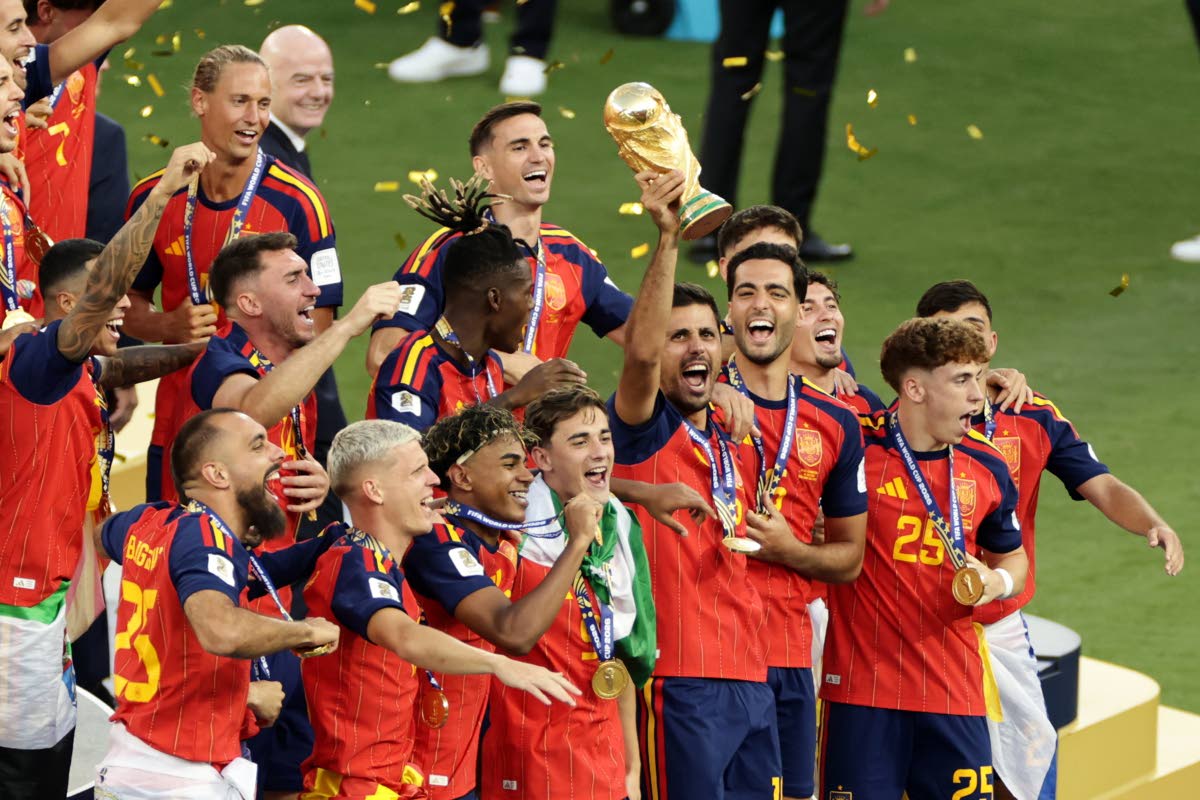 Members of the Spain national team celebrate winning the World Cup yesterday in New York. AP
-
Members of the Spain national team celebrate winning the World Cup yesterday in New York. AP
-
 Michael Abrahams Contributed
Yamal to Porro to Williams to Torres to … GOOOOOAL!
More than two weeks after Spain’s extra-time 1–0 victory over Argentina in the FIFA Men’s World Cup final, I still find myself replaying that winning goal. Spain deserved to win. They were consistent, conceding just one goal throughout the tournament, the fewest ever by a winner, while captain Rodri set a World Cup record with 756 completed passes during the competition. Spain dominated the final with 65 per cent possession, taking 20 shots (11 on target), and Pau Cubarsí completed 121 passes, a record for a World Cup final. Argentina failed to register a single shot in 90 minutes of regulation time, the first finalist to ever do so, and their two attempts in extra-time were off target.
Argentina’s supporters frequently dismiss claims that their team employs dirty tactics, but the statistics tell a different story. For instance, although Lionel Messi was the tournament’s most-fouled player, receiving 20 fouls, Argentina also committed the most fouls (113), including 25 in the final, the highest tally of any team in a single match at this World Cup. The only side ever to commit more fouls in a World Cup final was La Albiceleste itself against France in 2022 (26), which remains the tournament record. They also finished with the most cards (14 yellow and one red) and now hold the record for the country that has received the most red cards in World Cup final matches (three), achieved when Enzo Fernández was sent off late in the second half.
Argentina also earned the dubious distinction of becoming the only team to instigate a brawl at a World Cup final. After the final whistle, defender Nahuel Molina punched Rodri, igniting a melee, with several Argentine players physically assaulting their Spanish counterparts. Leandro Paredes struck Eric Garcia in the throat before shoving Gavi to the ground, Thiago Almada also wrestled Gavi to the turf, and assistant coach Roberto Ayala struck Dani Olmo.
Unfortunately, such conduct is not an isolated incident but part of a long-established pattern.
Following their 2006 World Cup quarter-final defeat to Germany, Argentine substitute Leandro Cufré kicked Per Mertesacker in the groin and received a red card after the match had ended, triggering a brawl that resulted in suspensions for Cufré, Maxi Rodríguez and Germany’s Torsten Frings. More recently, during their quarter-final match, dubbed the ‘Battle of Lusail’, against the Netherlands at the 2022 World Cup, another altercation erupted after Paredes harshly fouled Nathan Aké near the sideline and proceeded to blast the ball directly into the Dutch bench. That match set a World Cup record for the most yellow cards (18) issued in a single game. A red card was also given to Dutch defender Denzel Dumfries.
The conduct of some of Argentina’s supporters has likewise reinforced negative perceptions of both the team and the country. At this World Cup, supporters from Cape Verde and Egypt reported racist abuse and beer and bottles being thrown at them in the stands. A female Argentine fan racially abused YouTuber IShowSpeed, who was also struck in the head by a thrown object at a match. Rival factions of Argentine supporters clashed in street fights in Atlanta, where a male supporter was arrested for racially abusing a female police officer, and others were filmed spitting on and trampling an English flag in Times Square. And, before their quarter-final against Switzerland, when a moment of silence was requested for South African player Jayden Adams, who had recently passed, a section of Argentine supporters continued chanting and drumming, ignoring the tribute.
Paredes claimed that his violent outburst was provoked because Spanish players celebrated disrespectfully in his face. Yet, Argentina has behaved in precisely the same manner. Seconds after Fernández equalised during their semi-final against England, defender Cristian Romero screamed and celebrated directly in the face of England goalkeeper Jordan Pickford. At the same time, unused substitute Valentín Barco sprinted from the bench and onto the field to taunt England’s players. Immediately after Argentina’s 2-1 victory, Barco led a group of his teammates to celebrate and goad the England bench. English midfielder Jude Bellingham reacted by hitting him on the back of his head, triggering a post-match confrontation. Following the match, several Argentine players also displayed a political banner reading “Las Malvinas son Argentinas” (The Falklands are Argentine), in breach of FIFA’s prohibition on political demonstrations.
Argentina’s sore-loser mentality extended beyond the pitch. After the final, Argentinian fans rioted in Buenos Aires, and a supporter launched a petition that amassed more than 100,000 signatures, alleging “controversial and corrupt” officiating by Slovenian referee Slavko Vinčić and demanding that the final be replayed, despite Argentina itself benefiting from several contentious refereeing and VAR decisions throughout the tournament. Also, Argentina’s President Javier Milei complained, without presenting evidence, that the governments of Brazil and Mexico, alongside the US Democratic Party, had financed and coordinated an anti-Argentina smear campaign.
FIFA has since opened disciplinary proceedings against the Argentine Football Association (AFA) and several individuals, resulting in various disciplinary charges being laid against Paredes, Molina, Almada, Ayala and Spain’s Gavi for assault and unsporting behaviour. Disciplinary proceedings are also planned to investigate potential breaches across multiple matches involving players, team officials and supporters. The alleged violations include using a sporting event for demonstrations of a non-sporting nature, team misconduct, discrimination and racist abuse, and breaching order and security at matches.
Argentina does not require anyone to orchestrate a smear campaign against it. The pattern of intimidation, indiscipline and entitlement displayed by certain players, officials and supporters speaks for itself, and the statistical record of misdemeanours is available for anyone willing to examine it. Had Argentina prevailed, the victory would have risked legitimising their toxic football culture. Spain’s triumph therefore represents more than simply winning the World Cup - it is also a victory for the values the beautiful game should embody.
Michael Abrahams is an obstetrician and gynaecologist, social commentator, and human-rights advocate. Send feedback to columns@gleanerjm.com and michabe_1999@hotmail.com, or follow him on X @mikeyabrahams.