Elizabeth Morgan | Emancipendence and strengthening relations with African countries
Loading article...
-
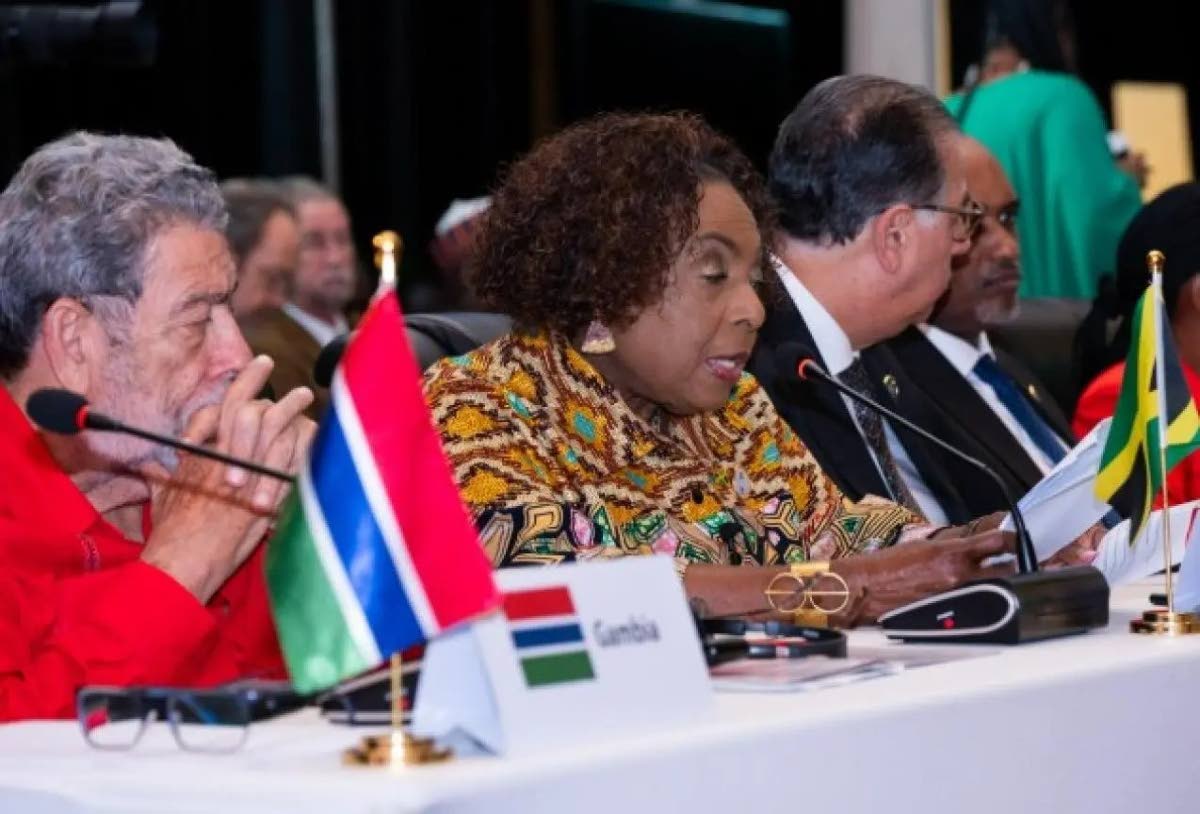 Minister of Culture, Gender, Entertainment and Sport, Olivia Grange, delivering remarks during the recent Reparations Conference in Ghana. Photo - JIS photo.
-
Minister of Culture, Gender, Entertainment and Sport, Olivia Grange, delivering remarks during the recent Reparations Conference in Ghana. Photo - JIS photo.
-
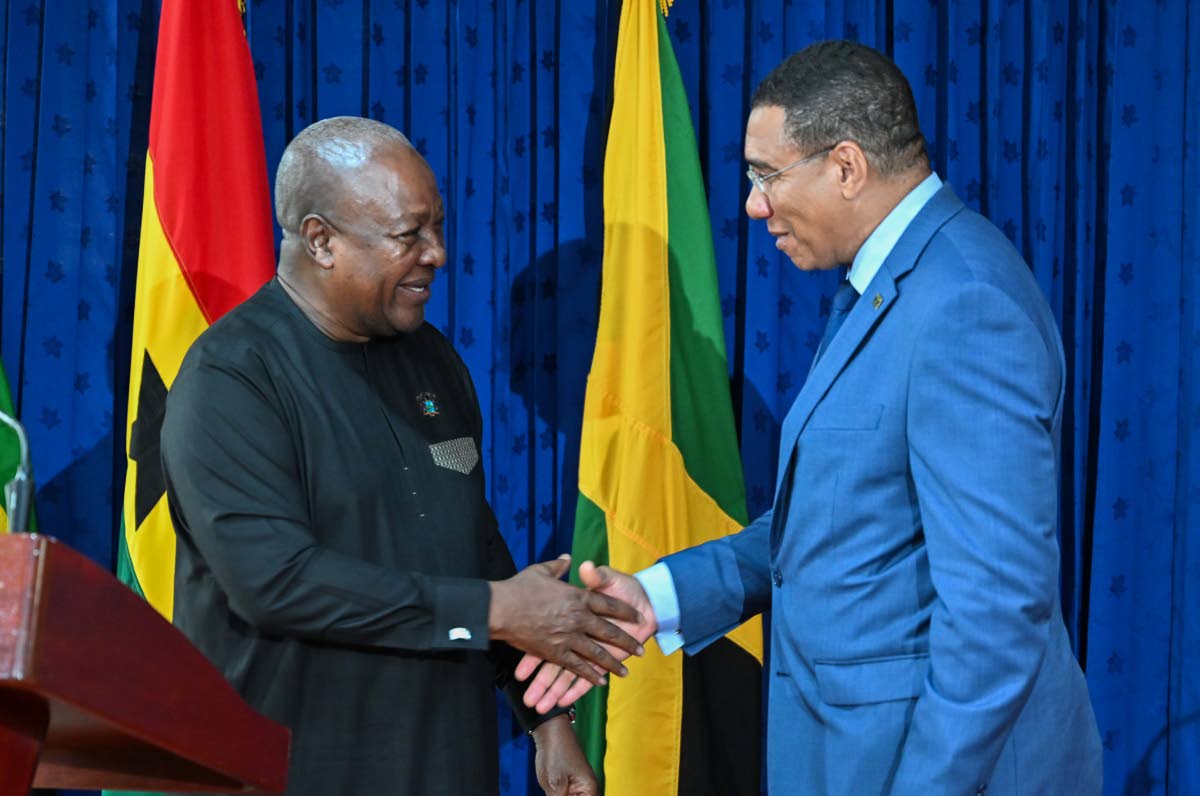 Prime Minister Dr Andrew Holness (right) greets President of the Republic of Ghana, John Dramani Mahama, ahead of a press conference following bilateral talks at the Office of the Prime Minister yesterday. Photo - Contributed
By a coincidence of dates, Emancipation Day, August 1, and Independence Day, August 6, are in the first week of August here in Jamaica. It allows for an informal linkage of this holiday season now called Emancipendence.
Emancipation Day marks the abolition of slavery in the British Empire in 1834, which was and remains an important event in history, not only in the British Empire and the then British West Indies, but also in the world. It would mark the movement led mainly by Britain to end the system of forced/enslaved labour in the world through the rest of that century. It would also place emphasis on the situation of working people, the importance of paid labour and decent working conditions. It should not be surprising that abolishing slavery, which was a worldwide practice, became a humanitarian priority of the League of Nations by 1924. Prior to that, the International Labour Organization was established in 1919 to promote fair working conditions and the rights of workers. The Convention to Suppress the Slave Trade and Slavery was adopted in 1926. Under the United Nations, it is now the 1956 Supplementary Convention on the Abolition of Slavery, the Slave Trade, and Institutions and Practices Similar to Slavery. Independence Day marks the right to self-determination advancing from a self-governing territory to independence as a separate sovereign nation ending the colonial relationship with Britain. This has been the route chosen by 12 members of the current Caribbean Community (CARICOM) as former British colonies. This column dealt with the issue of self-determination most recently on July 22.
Strengthening CARICOM/Africa relations
These days, as members of the African diaspora, CARICOM has been endeavouring to strengthen relations with Africa through the African Union (AU). In this decade, the means has been through what were supposed to be annual CARICOM/Africa Summits of which only two have been held so far, and the annual observance of CARICOM/Africa Day on September 7. The African Export-Import Bank (Afreximbank) has been operating in the Caribbean to promote trade and investment and achieve economic emancipation. There have also been several attempts to establish an air link between Africa, through Nigeria, and the Caribbean. A Nigerian air service is now operating between Nigeria, Antigua and Barbuda, and Barbados.
A CARICOM diplomatic mission opened in Nairobi, Kenya between 2019 and 2022 but it appears that Barbados is the only CARICOM country currently resident there.
You may also recall that several CARICOM countries were aiming to improve relations with Morocco, which has an embassy in St Lucia.
It now seems that a central link for the relationship between CARICOM and African countries is becoming the quest for Reparatory Justice (Reparations) for the Transatlantic Slave Trade. This was a central point at the second CARICOM/Africa Summit held in Addis Ababa in Ethiopia in September 2025. Recall, too, that Ghana led on the adoption of the UN General Assembly Declaration of the Trafficking of Enslaved Africans and Racialized Chattel Enslavement of Africans as the Gravest Crime against Humanity, which was adopted in March.
The Government of Ghana has invited Prime Minister (PM) Andrew Holness, along with PM Mia Mottley of Barbados, and former PM Ralph Gonsalves of St Vincent and the Grenadines, to join their newly established Global Advisory Council on Reparatory Justice.
Strengthening Jamaica/Africa Relations
On the diplomatic level, Jamaica has not expanded its presence in Africa, still only having resident representatives in Nigeria and South Africa. On the African side, Kenya recently joined Nigeria and South Africa with diplomatic representation in Kingston.
In the relationship with Ghana and others, the government of Jamaica had appointed Marjorie Grant Fuller as ambassador/special envoy to four African countries, Ghana, Nigeria, South Africa and Togo in 2021. This was to be another step in the government’s bid to deepen its outreach to the continent and to identify specific opportunities for enhancing trade and investment to support Jamaica’s economic development.
Foreign Minister Kamina Johnson Smith visited Ghana in May to revive the Jamaica-Ghana Permanent Joint Commission for Cooperation, re-establishing formal ties in health, trade, education, and defence. This joint commission last met in 2005. A main outcome was a memorandum of understanding under which 400 nurses will come to work in Jamaica.
Jamaica officially joined the Afreximbank in July 2025 and a road show was held by the bank in July this year. This gives Jamaica access to a pool of funds designated to promote trade and investment projects.
There have been some reported cultural exchanges with Ghana, but little progress in trade is seen with Ghana and other African countries.
Visiting African dignitaries
During this Emancipendence period, the government of Jamaica is hosting the current President of Ghana, John Dramani Mahama, on a state visit.
The Jamaica Information Service also informs that South Africa’s Deputy Minister of International Relations and Cooperation, Alvin Botes, will visit the country from August 4 to 7.
We hope that more progress will be made during these visits on trade and economic issues and that the primary focus will not be only on matters of reparatory justice.
The foundation of a CARICOM/Africa partnership should be trade and economic collaboration, especially in this very uncertain global environment.
Elizabeth Morgan is a specialist in international trade policy and international politics. Send feedback to columns@gleanerjm.com.