Fr. Sean Major Campbell | Beyond victory: Football and faith
Loading article...
-
 Major-Campbell
-
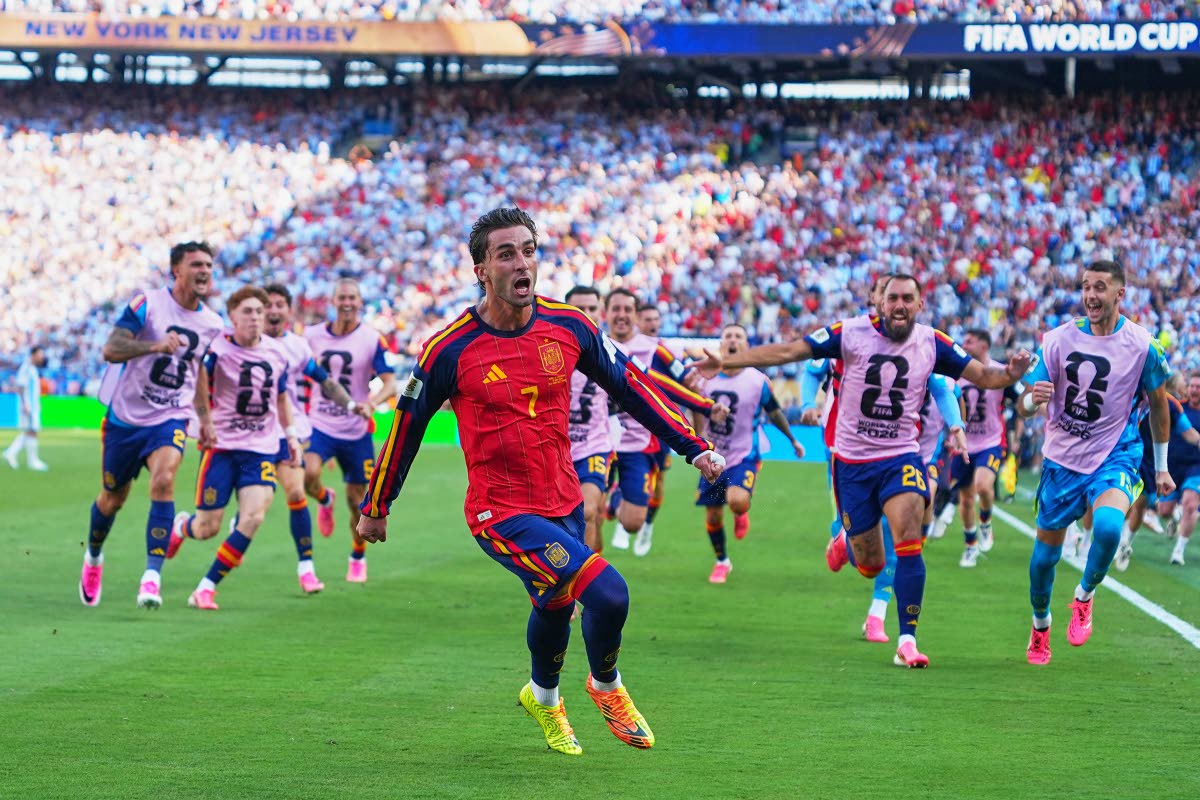 Spain’s Ferran Torres (7) celebrates after scoring the winner against Argentina during the World Cup final in East Rutherford, New Jersey.
-
The FIFA World Cup Football has certainly provided material for theological and ethical consideration. It was good to see the celebration of diversity in terms of nationalities, languages, races, colours, and cultures. International competitions facilitate much-needed engagement, informed by ethical rules and guidelines regarding conduct on and off the field.
It is always a worthwhile reminder that people from all walks of life have talent, skill, and intelligence that are not determined by phenotypic characteristics. It is also of significance that people are becoming more aware of the history of oppression brought on their ancestors and the ongoing impact of colonialism, colourism, and racism in the presentation of teams today.
While people pray for victory in their various games, does it matter to God whether or not your favourite team wins? Should people pray against their opponent in such games? Does it matter to God who wins the World Cup? I believe it borders on making God petty, to suggest that God is on your side for goals. Maybe our prayers should be for goodwill, safety, and the advancing of our best humanity as we interact with our opponents.
Any image from the sporting arena that is used to illustrate theological messaging ought to be grounded in ethical discourse. Winning is not an end. How the playing, qualifying, and goal-making processes are made are also important. Philippians 3:14 state, “ I press on toward the goal to win the prize for which God has called me heavenward in Christ Jesus.” That “pressing on” involves the preparation and the work. Players are coached to understand and execute precise passing, tactical movement, clinical finishing, delivering accurate crosses, and so on.
The life of religious faith requires faithfulness that is characterised by thinking, strategising, and always keeping the goal in focus. The objectives of football include ball and goal. The object of the Christian life is faith in God. While football employs attacking strategies and tactical movements, Christianity must employ the “armour of faith”.
In the same way that attacking teams unite players in an area of the pitch to keep focus and outnumber the defending team, there are times when the Christian is attacked by all kinds of challenges and situations. Trouble comes in more than the proverbial threes. And misery loving company appears to be proven. But, amid overloads, attacking midfielders and wingers must secure positions in that space between the opponents’ midfield and defensive lines. And what joy and inspiration when the player receives the ball and turns with a chance to shoot directly towards the goal.
Chances are chances. A chance at goal does not always equate with accomplishing a goal. This is life. There are many misses. However, the consistent and increasing attempts at goal bear fruit sometimes.
RELIGIOUS FAITH AND FOOTBALL
Interestingly, while religious faith is not a requirement for footballers (though some are committed believers in various faith traditions), the Christian life calls on the follower of Christ to be strong in the Lord. In Ephesians 6:10-12, the Church in Ephesus is admonished, “ Finally, be strong in the Lord and in His mighty power. Put on the full armor of God, so that you can take your stand against the devil’s schemes. For our struggle is not against flesh and blood, but against the rulers, against the authorities, against the powers of this dark world and against the spiritual forces of evil in the heavenly realms.” Paul was not writing to footballers. But isn’t this an interesting application even for ethical concerns in sports today?
Even in sports, there may be conflicts with rulers and authorities, manifesting in ethical concerns. Meanwhile, the Christian life requires a recognition that the forces of evil are not always confined to those on the immediate field around us. Sometimes those working against the ways of righteousness and peace are in other spaces and under other powers. The powers of this dark world and the spiritual forces of evil are realities that we dare not ignore!
An interesting consideration is the fact that, in football, it is quite okay for a fast attacker to run onto a through-ball before the goalkeeper can get to it. That is what the attacking team wants. But, what happens in the walk of faith when the attack is not fast enough?
Maybe one of the most important lessons about football is the importance of working together. Team members know when to give-and-go and so on. They remember also that there is no win without collective working together. It is to be noted, though, that while the fittest and fastest are great assets to the game of football, the life of Christian faith includes everyone. Even the slow and the weak. No wonder, Paul advises in Ephesians 6:14-17: “ Stand firm then, with the belt of truth buckled around your waist, with the breastplate of righteousness in place, and with your feet fitted with the readiness that comes from the gospel of peace. In addition to all this, take up the shield of faith, with which you can extinguish all the flaming arrows of the evil one. Take the helmet of salvation and the sword of the Spirit, which is the word of God.”
CHRISTIAN FAITH FOR A LIFETIME
Analogies do present with their own challenges. Football requires discipline and may employ the use of various strategies and finishing techniques. Play is done for two hours with the likelihood of extra play time. The Christian walk of faith is for a lifetime.
Both football and religious faith traditions are prone to corruption. Christianity, however, demands faithfulness above skill, surrender above brilliance, and a “crown” for all who endure. James 1:12 is not for the winning team; but for the faithful individuals: “ Blessed is the one who perseveres under trial because, having stood the test, that person will receive the crown of life that the Lord has promised to those who love him.”
Fr. Sean Major-Campbell is an Anglican priest and advocate for human rights and dignity. Please send feedback to columns@gleanerjm.com and seanmajorcampbell@gmail.com