AI reshaping Brazilian agriculture
Loading article...
-

Director of Agrisolus Fernando Mizot
-
 Chief Technology Officer at Ecotrace , Eric Luque.
-
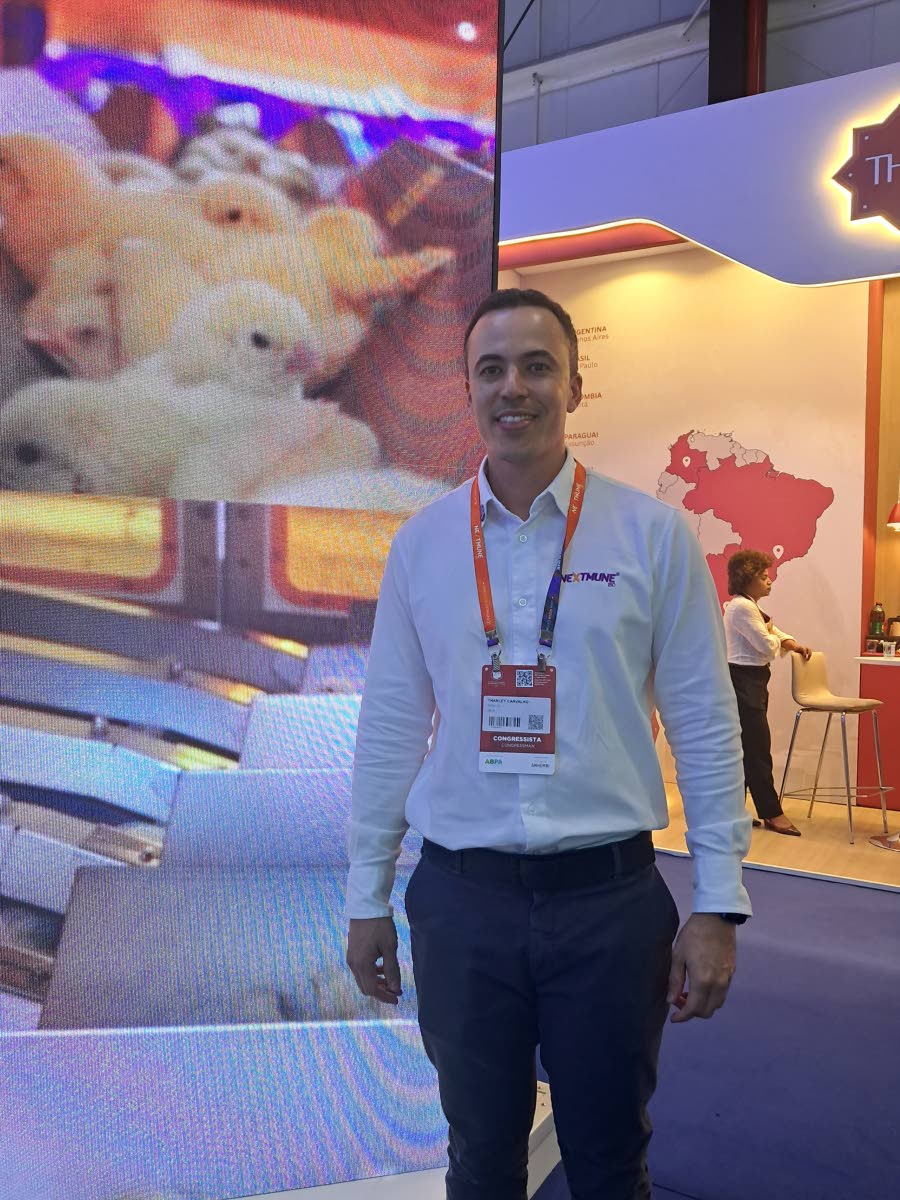 Marketing Manager at Ceva Tharley Carvalho.
From detecting sick chickens to tracing beef from farm to fork, artificial intelligence (AI) is reshaping Brazilian agriculture, with lessons that could help improve productivity and food security in Jamaica and the wider Caribbean.
The emerging technologies were on display at the International Animal Protein Show (SIAVS) in São Paulo, Brazil, from August 4-6, one of Latin America’s largest poultry and animal-protein exhibitions, where industry leaders demonstrated how AI is transforming different stages of food production.
Among the 400 exhibitors was Agrisolus, a Brazilian technology company that has spent the past seven years developing AI-powered systems to monitor poultry farms.
Company Director Fernando Mizote said the company’s technology combines cameras, sensors, data analysis and cloud computing to continuously assess bird health and farm conditions.
“We are looking for the wellness of the poultry,” Mizote said. “If a bird is feeling okay, the bird will eat well, will gain weight, and will improve the performance for the farm.”
Using computer vision, the system can detect whether birds are comfortable, stressed, feeding, sleeping, moving normally or showing other behaviours.
“We think that if a human can detect a behaviour that is desired to be detected, we will train the machine to do it as well,” Mizote said.
Sensors also monitor temperature, humidity and carbon dioxide levels, while the system tracks feed availability and consumption.
The information is analysed through a cloud-based system, which sends alerts to farmers and technicians on their mobile phones when conditions fall outside desired parameters.
Rather than discovering problems after an entire production cycle, farmers can intervene while the birds are still being raised.
“We can detect disease, a lack of water, a lack of feed, a wrong climate setting,” Mizote added.
He said the technology can also help farmers reduce mortality, improve growth and achieve better feed conversion by identifying problems in real time.
Agrisolus has customers throughout Brazil and some outside the country, and Mizote said the technology is suitable for farms of different sizes.
He said some of the greatest improvements are seen among producers who are underperforming, because the technology helps identify weaknesses in their operations.
“The customer that gets the best performance improvement is the worst one, because with the equipment they see where they are doing wrong,” Mizote said.
BENEFICIAL TO POULTRY FARMERS
Mizote believes the system could benefit poultry producers in Jamaica and other Caribbean countries.
However, he suggested that an industry integrator validate the technology before individual farmers adopt it.
He said the biggest benefit is the ability to correct problems during production, rather than waiting until the end of the cycle.
“They don’t need to wait until the end to notice what is going wrong,” Mizote said. “During the lot of production, they can correct what is going wrong in real time and get a better performance.”
Based on his observations, Mizote said more farmers and producers across different agricultural sectors are increasingly turning to artificial intelligence and other technologies to improve production and efficiency.
“We see that they are more open to new technologies because it’s not difficult to use them; it’s very easy,” he said.
AI is also being used to strengthen traceability in Brazil’s agricultural sector.
Eric Luque, chief technology officer at Ecotrace, said the company has spent about 10 years developing its traceability technology, with the company launching the system in 2018.
The development process involved extensive research, testing cameras and other equipment, and developing the software and algorithms needed to analyse information from different regions.
“It’s very difficult to work in agribusiness in Brazil,” Luque said, noting that Brazil’s vast territory means conditions can vary significantly from one region to another.
According to Luque, the company uses artificial intelligence to trace beef and cotton and provide information about the origins and production conditions of agricultural products.
“What we do here is try to provide the traceability for abroad companies to buy our products here in Brazil,” Luque said.
For beef buyers, the system can determine whether cattle came from farms that meet environmental and social requirements.
The technology uses satellite imagery, government data and other information sources, which are cross-referenced using artificial intelligence.
Among the problems it can identify are deforestation and illegal burning.
“We use artificial intelligence to cross the information about those sources and put everything together,” Luque said.
Ecotrace works with major Brazilian meat processors, including JBS, Minerva Foods and BRF, and has customers in several international markets.
APPLICATIONS IN JAMAICA
Luque said the technology could also have applications in Jamaica, particularly as the country imports agricultural products.
“In Jamaica, of course, you import a lot of agricultural products,” he said. “You can use my system to ensure you are buying cattle, poultry, cotton stuff, clothes, products with no social environmental problems.”
The system provides what Luque described as “farm to fork” traceability, allowing buyers to establish the origin of products and determine whether suppliers meet required standards.
Ecotrace has also developed AI technology for slaughterhouses.
Its Echo AI system uses cameras to monitor and classify activities during processing, identifying issues including bruises, fractures, contamination, feathers and equipment or operational failures.
“We have more than 20 items that we can check for,” Luque said.
The information is displayed on a dashboard, allowing processors to monitor operations in real time.
“The AI is the heart of the system,” Luque said.
He said not every issue detected automatically means meat must be rejected, as the response depends on the nature of the problem.
“Some issues are okay and they just let go. Some issues are contaminations, for example,” he said.
Another exhibitor, Ceva Saúde Animal, highlighted how AI is being used to improve animal health and hatchery operations.
Tharley Carvalho, a veterinarian and marketing manager for Ceva’s Poultry Business Unit, said the French company is among the world’s five largest animal-health companies, with a strong focus on Brazil’s poultry industry, where it promotes vaccination for broilers, breeders and layers.
Carvalho said artificial intelligence is relatively new to the company, but is becoming increasingly important because of the large amount of data generated by the poultry industry.
He explained that the company is using AI to process large amounts of field and research data, including information that can help assess vaccine performance.
Carvalho further noted that AI is particularly useful in research and development, where scientists have to process large volumes of information.
He also shared that Ceva is beginning to use AI in hatcheries through a machine that separates male and female chicks.
The process was traditionally performed manually, but the new system uses images to determine the sex of chicks within seconds and directs them into separate boxes.
“They take, like, 50 photos and separate [the chicks] instantaneously, like seconds,” Carvalho said.
“It brings a lot of accuracy and makes the process fast. And you don’t need a lot of people doing that.”
SEEKING GREATER EFFICIENCY
The technology is being introduced at different hatcheries as Brazil’s poultry industry seeks greater efficiency.
Brazil produces about 7.4 billion broilers annually and is the world’s leading exporter of poultry meat, making animal health, disease prevention and food safety critical to maintaining its position in international markets.
Carvalho, in the meantime, added that vaccination remains an important part of Brazil’s poultry industry, with Ceva producing vaccines against diseases, including laryngotracheitis, bronchitis and Gumboro.
“Brazil is the most important meat exporter in the world,” he said. “And so, one difference for the Brazilian quality is our health, sanitary quality.”
The technologies showcased at SIAVS demonstrate that artificial intelligence is increasingly moving beyond experimentation and into everyday agricultural operations.
For Jamaica and the wider Caribbean, the Brazilian experience points to potential opportunities to use technology to improve productivity, strengthen food safety and make agricultural production more efficient.
The biennial animal-protein show, organised by the Brazilian Association of Animal Protein, featured about 400 exhibitors and attracted representation from 65 countries. The event is aimed at driving international trade, while showcasing cutting-edge agricultural technologies across the poultry, pork, beef, egg and aquaculture sectors.
tanesha.mundle@gleanerjm.com