Teachers trained to bring coding into classrooms
Loading article...
-
 The micro:bit puts coding and physical computing into the hands of learners, transforming a compact device into a gateway for creativity, innovation and digital skills.
-
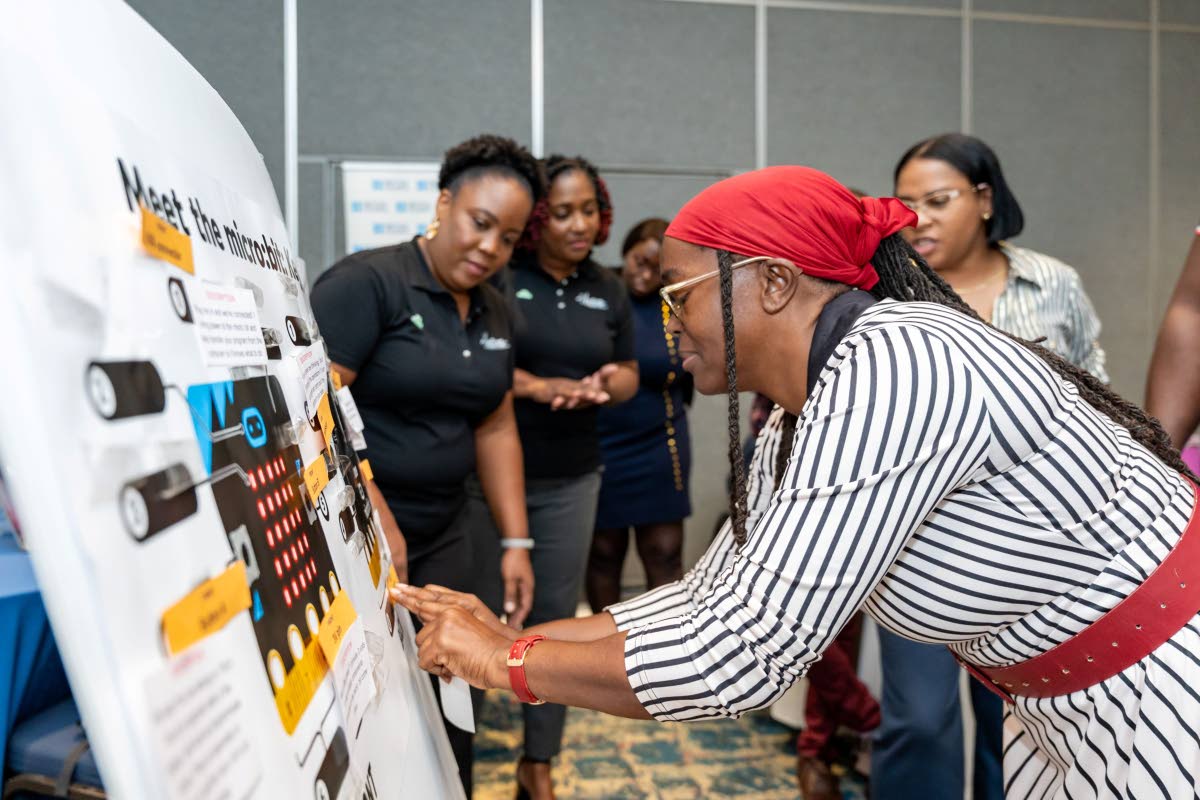 A participant explores an interactive micro:bit display supported by members of the Grace & Staff Community Development Foundation team.
Grace & Staff Community Development Foundation has trained teachers and education-sector partners in the use of the micro:bit, a programmable device designed to build coding and digital skills among students, as part of its drive to expand STEM education in Jamaica.
The Training of Trainers workshop, held in late August on behalf of the UK-based Micro:bit Educational Foundation, forms part of the foundation’s wider STEAM in Education Programme. The session was designed to equip educators with the practical skills and confidence needed to integrate the technology into classroom instruction while meeting National Standards Curriculum objectives.
The micro:bit is a pocket-size programmable computer designed to introduce young people to coding and digital technology through hands-on learning. Equipped with an LED display, buttons, sensors, a compass, accelerometer and Bluetooth connectivity, it enables students to create and programme a wide range of projects. These include games, animations, digital thermometers, step counters, environmental monitors and interactive devices that respond to movement, light and temperature.
The technology can also be used to collect and analyse real-world data, supporting learning in science, mathematics, engineering and technology.
Led by Dhira-Mae Brown-Douglas, Grace & Staff’s STEM administrator, the foundation’s facilitation team guided participants through technical instruction, practical exercises and collaborative learning. Teachers learned how to set up and use the micro:bit, explored coding through the development of various programmes, and worked together to create classroom-ready activities and lesson plans aligned with curriculum objectives.
According to Sandrina Davis, CEO of Grace & Staff, the initiative reflects the foundation’s commitment to ensuring that investments in technology translate into meaningful learning experiences for Jamaican children.
“Providing technology is important, but empowering teachers to use that technology confidently and purposefully is where the real impact begins. Our aim is to help educators move beyond simply knowing how the micro:bit works to understanding how it can be integrated creatively into lessons to strengthen problem-solving, critical thinking, collaboration and other skills our young people will need for the future,” said Davis.
She said the workshop also gave Grace & Staff an opportunity to share expertise gained through its own programmes with a wider group of educators.
“For Grace & Staff, this is another important step in our work in STEM and digital education. Having incorporated the micro:bit into our own programmes since 2023, we are pleased to now share that experience more broadly. We are proud that our team has been able to contribute its knowledge and expertise to an initiative with the potential to influence teaching and learning across Jamaica.”
The initiative complements Grace & Staff’s broader investment in education. The foundation’s annual tuition-assistance programme benefited 1,200 students this year, while its homework-centres initiative is expected to support 400 students across five communities during the 2026-27 school year.