Aubrey Stewart and Keenan Falconer | The cost of running the State: Can the economy sustain it?
Loading article...
-
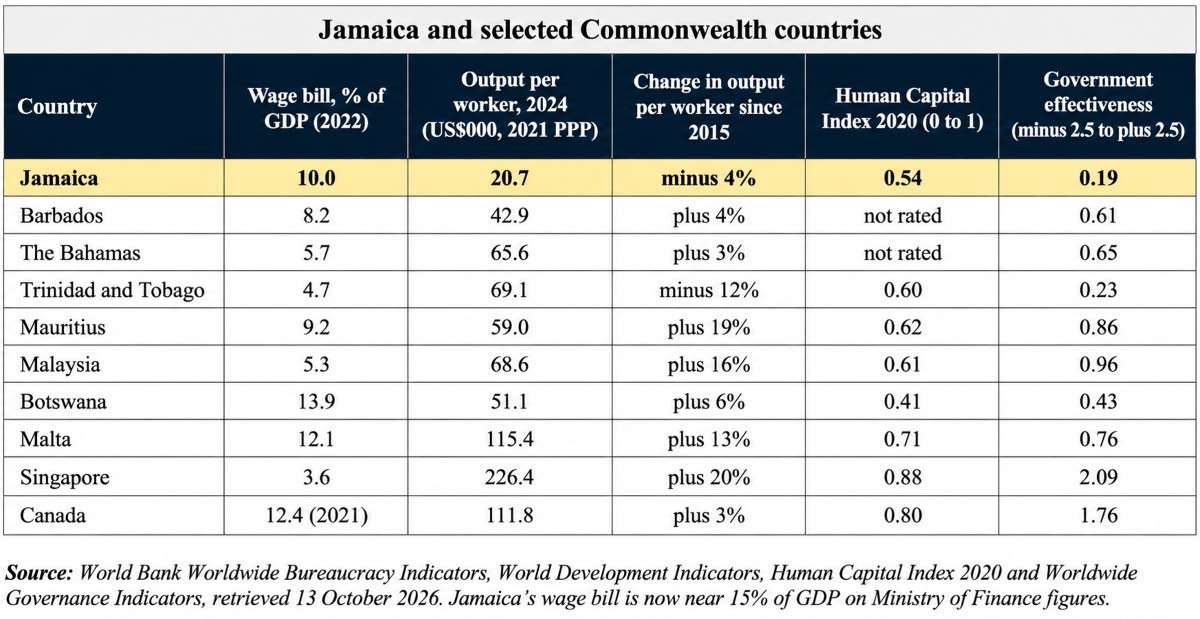 Photo - Contributed
-
Photo - Contributed
-
 Aubrey Stewart. Photo - Contributed
-
 Keenan Falconer. Photo - Contributed
The proverbial nine-day wonder seems to be changing, and the National Reconstruction and Resilience Authority (NaRRA) may well be the catalyst for the next five years when it comes to issues that would otherwise become silent public cries.
NaRRA signed a five-year lease on the Kingston waterfront at about J$115 million a year. Within days, the Cabinet said the space could be reduced by as much as half. Meanwhile, some families in western Jamaica are still living under tarpaulins nearly a year after Hurricane Melissa.
The controversy deserves scrutiny. However, the NaRRA lease represents less than 1 per cent of what central government spends annually on rent. The rental bill for central government ministries, departments, and agencies (MDAs) has grown from J$5.1 billion in 2019-20 to J$13.6 billion in 2025-26, an increase of about 166 per cent. It is projected to reach J$16.9 billion by 2029-30.
The lease may be the highlight, but there is a deeper story: the cost of running the State is rising much faster than the economy that must sustain it. The question is not whether Government is spending more but whether the economy is producing enough to sustain that spending.
PAY HAS OUTRUN OUTPUT
Since 2021-22, the last year before compensation restructuring began, the central government wage bill has risen from J$242 billion to J$522 billion, an increase of 116 per cent. Over the same period, nominal GDP increased by 39 per cent, while real output increased by just 2.6 per cent.
Hurricane Melissa explains part of the recent gap but not most of it. By 2024-25, before the storm, the wage bill was already 88 per cent above its 2021-22 level, while real output had increased by only about 7 per cent.
This does not mean that a 116 per cent increase in wages should produce a similar increase in GDP. But the cost of the State must bear some relationship to the productive capacity of the economy financing it.
Compensation of employees has moved from 9.5 per cent of GDP to 14.8 per cent. Before restructuring, 36 cents of every tax dollar went to public wages. It is now 49 cents and is expected to reach 54.4 cents by the end of this fiscal year.
The comparison with capital spending is striking. Capital expenditure was just 1.6 per cent of GDP in 2025-26. For every dollar the State invested in roads, schools, buildings, and other capital projects, it spent more than nine dollars on pay.
None of this means compensation restructuring was wrong. Public-sector wages had fallen behind, and restructuring was necessary. Public servants should be properly compensated.
The problem is that the pay side of the bargain has been delivered. The productivity side has not.
SKILLS ARE THERE; OUTPUT IS NOT
On human capital, Jamaica does reasonably well. The World Bank named Jamaica a Human Capital Champion, and the country scores above the Latin America and Caribbean average on its Human Capital Index Plus. The challenge is converting that human capital into output.
A Jamaican worker produces about US$8.81 of GDP per hour, less than half the Caribbean average of US$20.50. World Bank data show that output per worker was lower in 2024 than in 2015.
The problem, therefore, is not education and training. Productivity depends on capital, technology, management, infrastructure, institutions, competition, and the environment in which businesses operate.
Crime matters, too. It discourages investment, reduces operating hours, and forces businesses to spend resources on security that could otherwise support expansion. The skills are there. The challenge is creating an environment that allows those skills to produce more.
HOW THE COMMONWEALTH COMPARES
The international comparison makes the problem clearer.
In 2022, Jamaica’s public-sector wage bill was approximately 10 per cent of GDP, compared with a peer median of 8.4 per cent. Today, it is approaching 15 per cent.
But a large wage bill is not necessarily the problem. The more important question is what the country receives in return. Canada and Malta spend about 12 per cent of GDP on public pay, but both have much higher output per worker and stronger government effectiveness than Jamaica.
Human capital alone is insufficient. Mauritius, Malaysia, and Trinidad and Tobago score only about 15 per cent higher than Jamaica on the World Bank’s Human Capital Index, yet each produces roughly three times as much per worker.
The difference is what surrounds the worker: capital, technology, management, institutions, competition, and safety. Paying people less does not automatically make an economy more productive. Paying people more does not automatically make it more productive either.
The question is what we produce in return.
WHERE THE DEBATE STANDS
The prime minister has said that inflation can no longer be the sole driving force behind wage demands and that compensation should increasingly reflect productivity and economic growth. The finance minister has proposed a ceiling on wages as a share of national output while the Independent Fiscal Commission has called for restoring a fiscal rule governing the wage bill.
The unions have a legitimate concern. Wage restraint has been tried before. Wage freezes contributed to skilled workers leaving the public service while inflation is eroding the current wage agreement.
Both sides have a point. A ceiling without productivity reform risks becoming another wage freeze while productivity talk without fiscal discipline becomes a blank cheque for uncontrolled wage growth. The task is to tie one to the other.
WHAT NEEDS TO CHANGE
First, growth in the public-sector wage bill should bear a reasonable relationship to economic growth rather than inflation alone. This should not mean another wage freeze. Public servants must receive reasonable increases, but those increases must be sustainable.
Second, performance management must measure actual performance. Jamaica cannot spend more than J$500 billion annually on public-sector compensation without being able to tell taxpayers what that expenditure produces. MDAs should identify measurable outputs, report them publicly, and connect incentives to results.
The questions are: What did the agency deliver? How well? At what cost? Did performance improve?
The same discipline should apply to Government’s property portfolio. Major leases should undergo transparent lease-versus-buy assessments. Government should maintain a public register of rented properties, identify underutilised space, and properly maintain buildings it already owns.
Third, capital investment must be protected. When recurrent expenditure grows faster than revenue, investment is often the easiest thing to postpone. Yet roads, water systems, schools, and technology help determine how productive workers and businesses can be. Government should merge public bodies where functions overlap and expand shared services where they reduce administrative costs.
Finally, Jamaica must turn human capital into output. The national productivity policy provides an opportunity, but it must go beyond training to address technology, research, investment, management, competition, and the costs imposed by crime and insecurity.
We cannot educate and train people, place them in systems that prevent them from being productive, and then wonder why productivity remains low.
OTHER HALF OF THE BARGAIN
The compensation restructuring was always supposed to be part of a larger bargain: public servants would receive better pay while the country would receive a more efficient and productive State.
Four years later, Jamaica has largely paid for the first half. The second half is overdue.
Public servants should be properly compensated, and the State must attract and retain skilled people.
But better compensation must ultimately be supported by a stronger economy, higher productivity, and better public services. Otherwise, an increasing share of the country’s resources will go towards maintaining the State rather than expanding its productive capacity.
The NaRRA lease will probably be forgotten ... the larger problem will not be.
More is being spent on wages, on rent, and on running the State while the economy struggles to produce substantially more. We can debate individual leases, salaries, and budgets, but eventually, the arithmetic catches up.
No country can sustainably keep paying more while producing less.
Aubrey Stewart, PhD, is a public policy researcher and consultant. Keenan Falconer is an economist. Send feedback to aubreymstewartiv@gmail.com and keenanjfalconer20@gmail.com