Ronald Sanders | Reflections on 250 years of American independence
Loading article...
-
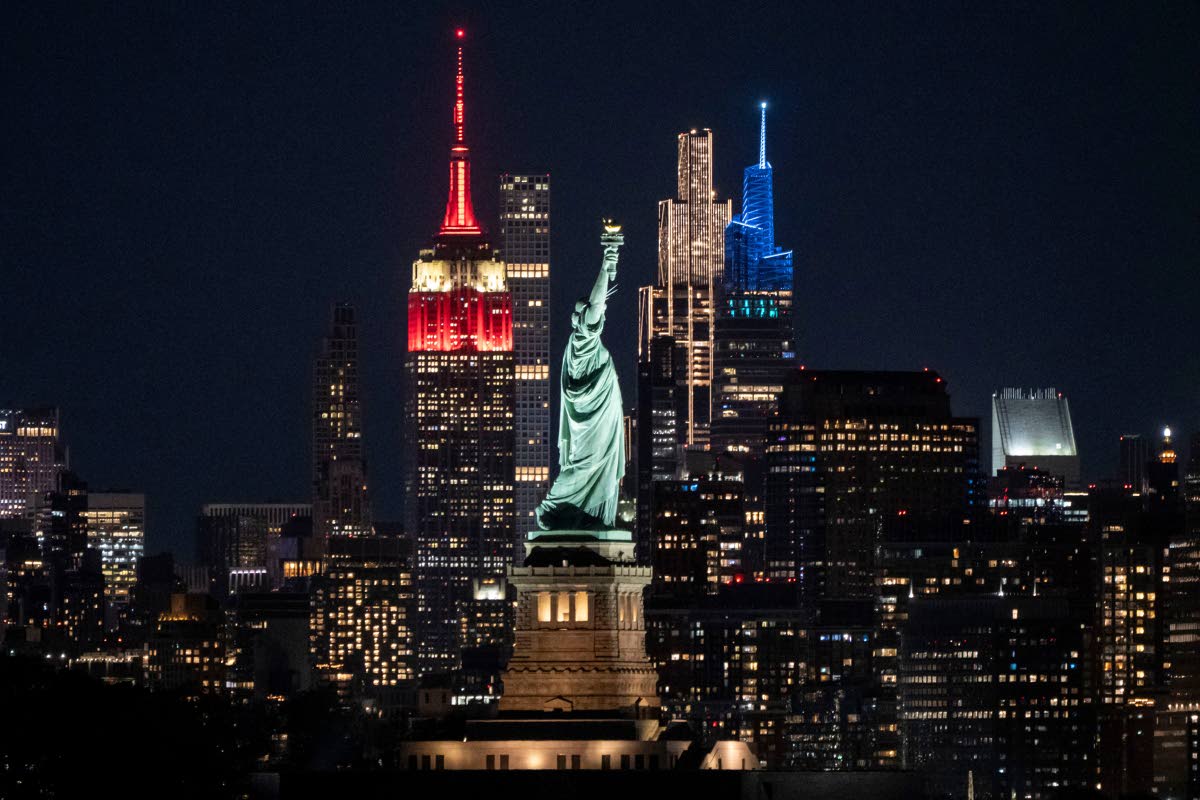 Statue of Liberty stands next to Empire State Building, left, in New York, as seen from Jersey City.
-
Statue of Liberty stands next to Empire State Building, left, in New York, as seen from Jersey City.
-
 Ronald Sanders. Photo - File
Two hundred and fifty years ago, in the sweltering heat of a Philadelphia summer, a small group of men did something without precedent in modern history. They gathered, argued, deliberated, and then signed their names to a declaration that was a declaration of war against the mightiest empire on earth. They did so knowing that, if they failed, they would almost certainly hang.
We mark that moment today as citizens of nations that were themselves shaped, directly or indirectly, by the audacity of what was proclaimed in Philadelphia on July 4, 1776.
The document they produced was remarkable in its language as much as in its courage. Its opening announced a philosophy of government that was revolutionary, challenging the authority of King George III and the British political establishment.
They declared:
“When in the Course of human events, it becomes necessary for one people to dissolve the political bands which have connected them with another, and to assume among the powers of the earth, the separate and equal station to which the Laws of Nature and of Nature’s God entitle them, a decent respect to the opinions of mankind requires that they should declare the causes which impel them to the separation.”
That single sentence challenged centuries of accepted thinking about the relationship between rulers and the ruled. Sovereignty, the patriots were saying, did not reside in the Crown. It resided in the people. A people who had endured what they described as “a long train of abuses and usurpations” had not merely the right, but the duty, to throw off such government and establish new institutions for their future security.
Yet there was another remarkable feature of that opening sentence which resonates just as strongly today. The Declaration was consciously addressed to world opinion. The founders understood that their cause required legitimacy beyond their own shores. They sought, in their own words, “a decent respect to the opinions of mankind”. In many respects, this was the beginning of modern public diplomacy. The founders understood that military victory alone would not secure legitimacy. They also had to persuade the wider world that their cause was just, and they appreciated that, even in the 18th century, ideas could travel farther than armies.
The Declaration went on to specify the grievances that justified separation. Among them was the charge that the King had “endeavoured to prevent the population of these States; for that purpose, obstructing the Laws for Naturalization of Foreigners; refusing to pass others to encourage their migrations hither.” It also accused him of combining with others to subject the colonies “to a jurisdiction foreign to our constitution, and unacknowledged by our laws”. These were grievances that many colonists genuinely believed they had suffered. They felt that fundamental rights to govern themselves, to make their own laws, and not to be taxed without representation, had been systematically denied.
Then came the second paragraph. Perhaps no passage has had a greater influence on the development of modern constitutional government.
“We hold these truths to be self-evident, that all men are created equal, that they are endowed by their Creator with certain unalienable Rights, that among these are Life, Liberty and the pursuit of Happiness. That to secure these rights, Governments are instituted among Men, deriving their just powers from the consent of the governed.”
Self-evident truths. Unalienable rights. The consent of the governed. Today, many nations regard these principles as fundamental to legitimate government, though they remain elusive under repressive regimes. In 1776, however, they were revolutionary. As Thomas Jefferson himself reflected 50 years later, the Declaration was “pregnant with our own and the fate of the world”. History has vindicated that judgement.
BEACON BEYOND BORDERS
The Declaration was addressed not merely to the 13 colonies, nor solely to the King of Great Britain, but, with “a decent respect”, to the opinions of mankind. Within months, translations had circulated across Europe, reaching France, the Netherlands, the German states, Scandinavia, and beyond.
Its greatest influence, however, was felt among peoples living under colonial rule or foreign domination. Scores of the nations now represented at the United Nations possess founding documents that are declarations of independence. The American Declaration provided the model, much of the language, and many of the principles for many of them.
Nowhere was this more dramatically demonstrated than in the Caribbean. Haiti, in January 1804, became the first Black republic and the first independent nation in the Western Hemisphere to abolish slavery. Its revolution drew inspiration from principles proclaimed in 1776, even though many leaders of the young United States recoiled from their full implications.
For the Caribbean as a whole, the ideals proclaimed in Philadelphia became a lasting source of inspiration. When our nations eventually raised their own flags and assumed sovereign statehood, they entered a tradition of self-determination whose roots reached, in part, to Philadelphia. The Declaration ultimately belonged not to America alone, but to all peoples seeking freedom.
MEN WHO MADE IT
It is right that, on this anniversary, free peoples should honour the remarkable men who gathered in Philadelphia and, despite their rivalries and competing ambitions, found common cause in declaring the rights and freedoms of human beings. John Adams, Benjamin Franklin, Thomas Jefferson, Roger Sherman and many others helped produce a document whose influence would far outlive them.