Editorial | Advancing reparations
Loading article...
-
 FILE - The United Nations logo is seen inside the 79th session of the United Nations General Assembly, Tuesday, Sept. 24, 2024.
-
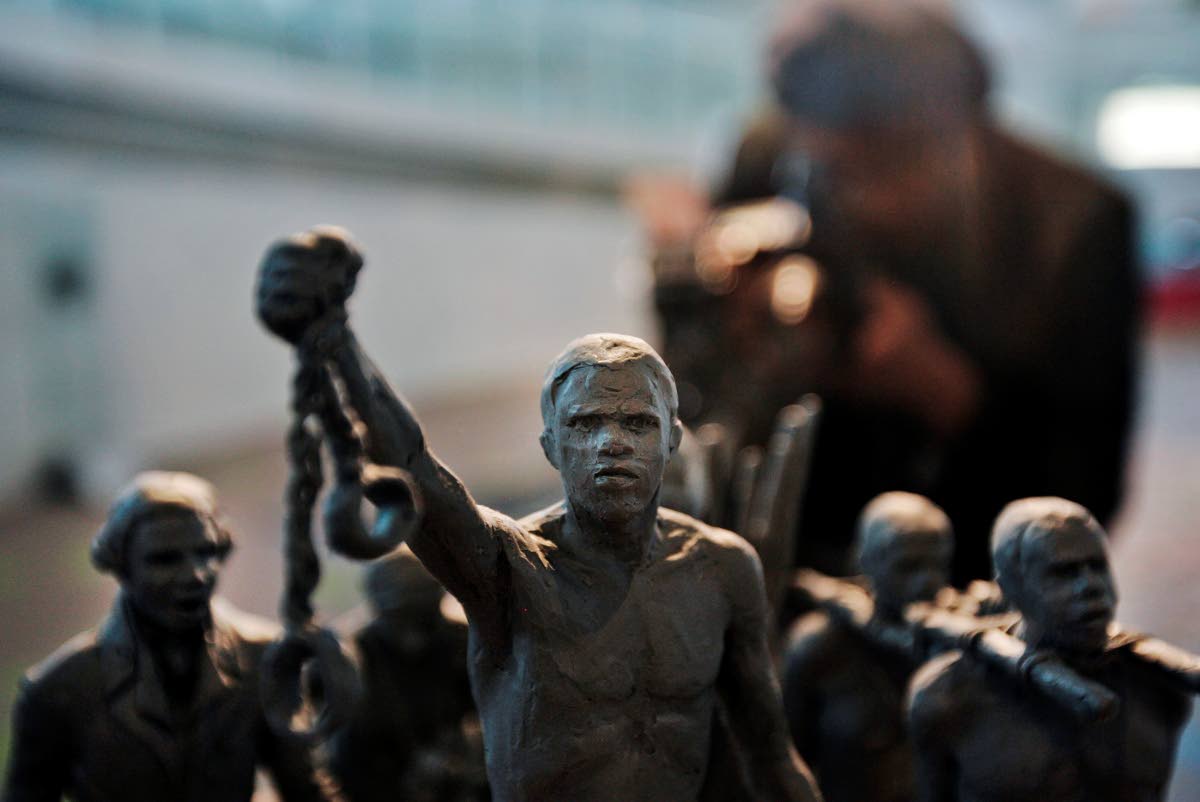 FILE - A man photographs a maquette of a statue, at City Hall, London, Monday, Aug. 18, 2008.
This newspaper celebrates Ghana’s spearheading of last month’s United Nations resolution declaring the transatlantic slave trade and slavery “the gravest crime against humanity”.
Indeed, a formal international declaration condemning this abomination against Africans and people of African descent – one that played out most brutally in the Americas – was long overdue. However, even as Ghana’s leadership of the UN initiative is rightly applauded, two important facts must be recognised.
First, the resolution itself makes clear that it is not an end in itself. Rather, it forms part of a broader process aimed at achieving reparatory justice. It therefore builds on nearly a decade and a half of sustained effort and leadership by the countries of the Caribbean Community (CARICOM). The region cannot now slacken, lose focus, or surrender either its commitment to or its place in this struggle, even as it embraces a wider partnership with engaged African nations.
Moreover, at a time when geopolitical stresses pose existential threats to CARICOM, the UN resolution – and the strategic advance it represents for the reparations agenda – highlights the value of regional integration and the gains that are possible when the Community acts collectively. All CARICOM member states were among the 123 countries that voted in favour of the resolution. Fifty-two countries abstained, while three voted against it: the United States, Israel, and Argentina.
Jamaica and its Caribbean partners have both a moral and a material obligation to pursue reparatory justice for a crime – one which the United Nations has now unequivocally declared took place in its gravest form – that carries no statute of limitations.
PROTRACTED GENOCIDE
During the 400 years of the transatlantic slave trade, more than 12 million Africans were captured and transported from the continent, primarily to the Caribbean and the Americas, where they were forced to labour on sugar and cotton plantations.
Indeed, of the approximately 800,000 people of African descent who were freed when Britain abolished slavery in its colonies in 1838, some 84 per cent (672,000) were in the West Indies. Jamaica alone accounted for 39 per cent (311,000) of all enslaved persons in British colonies and 46 per cent of those in the British West Indies.
Yet beyond the indignity and physical suffering of chattel slavery lay an immense waste of human life, a reality underscored by Jamaican sociologist Professor Orlando Patterson in his Rex Nettleford Lecture three years ago.
Professor Patterson noted that between 1650 and 1830, just over one million Africans were brought to Jamaica, while roughly 388,000 were taken to North America.
At the end of slavery in Jamaica, there were only 311,000 enslaved people to be freed. By contrast, in 1830, the United States had a Black population of two million. Using regression analysis, Professor Patterson concluded that Jamaica should have had 5.73 million Africans at that point.
The disparity between the population outcomes of the United States and Jamaica – where plantation owners were substantially wealthier – was, Professor Patterson argued, the result of differing treatment of enslaved people. In Jamaica, it was deemed more economical to acquire new enslaved labourers than to maintain the basic welfare, health, and lives of those already working on the plantations.
Professor Patterson’s overarching conclusion was stark: the 5.7 million “missing” Africans in Jamaica – the difference between the actual enslaved population at emancipation and the population that should have existed – represented the outcome of a “protracted genocide”.
UNIMPEACHABLE ARGUMENT
The end of the slave trade and slavery did not mean the end of the structure or effects of the system.
As the UN resolution itself notes, “the legacies of slavery and the transatlantic slave trade persist today in the form of structural racism, racial inequalities, underdevelopment, marginalisation, and socio-economic disparities affecting Africans and people of African descent in all parts of the world”.
In these circumstances, the Caribbean has an overwhelmingly compelling moral and legal case for reparations –one that CARICOM, through a high-level committee established in 2013, has been advancing in global forums.
That movement has received added impetus from the region’s kith and kin in Africa. The African Union, led by Ghana, is pressing for reparatory justice for the continent as redress for the effects of the slave trade. The AU has declared the period 2026 to 2035 the Decade of Action on Reparations and is working in partnership with CARICOM on this issue.
This is a positive and strategic alliance that should be expanded into other areas of cooperation.
However, as CARICOM knows from more than 13 years of concentrated effort on reparations – and given the contortions and careful parsing of the resolution by certain nations – securing state acknowledgment of responsibility for “the gravest crime against humanity”, and agreement on reparatory justice, will not be easy.
Nonetheless, the resolution makes an unimpeachable argument in asserting that, under international law, “states bear responsibility for internationally wrongful acts”, have “an obligation to cease the act”, and are required “to make full reparation for the injury caused, which may take the form of restitution, compensation and satisfaction, either singly or in combination”.
In that regard, The Gleaner supports the call for the countries involved in the transatlantic slave trade and racially based chattel slavery to engage in “good-faith dialogue on reparatory justice” with the descendants of their victims.