Peter Espeut | Proving illicit enrichment
Loading article...
-
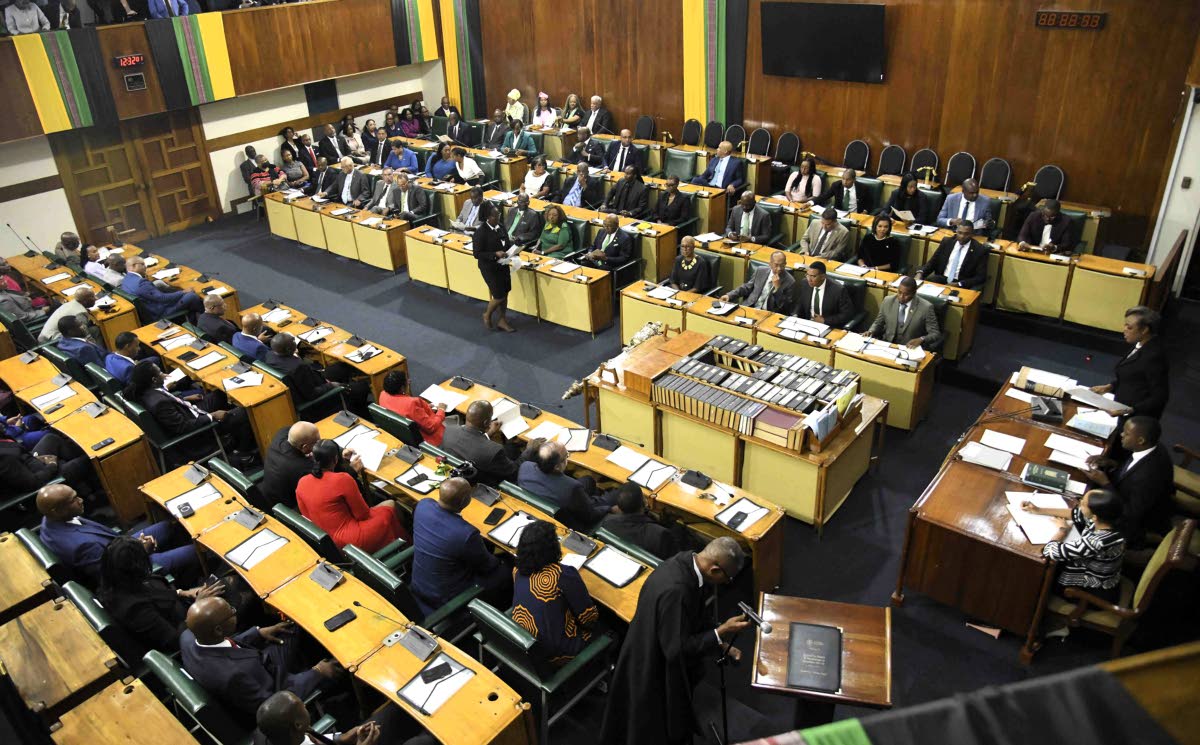
Members of Parliament before at the swearing-in for members of the upper and lower Houses of Parliament, held on September 18, 2025, in Gordon House.
-

Peter Espeut
On Tuesday June 7, the 2025/2026 Annual Report of the Integrity Commission (IC) was tabled in Parliament.
The second table on page 43 advises us that, during the period April 1, 2018 to March 31, 10 members of parliament (MPs) and three senators were referred for prosecution for failure to provide the IC with information as required by law; and that 14 MPs and one senator were referred for investigation of potential illicit enrichment and/or knowingly submitting false information to the IC.
Further, the table on page 44 advises that, over the same period, there were rulings to charge/prosecute two MPs and one senator for failing to provide information and, in fact, one MP and one senator were prosecuted.
And the same atble advises that, again over the same period, there were rulings to charge/prosecute one MP for illicit enrichment and/or knowingly submitting false information to the IC, and another ruling not to charge an MP; six investigations were closed.
I find these data curious.
Put aside the illicit enrichment for the moment. Either the 10 MPs and three senators provided the IC with all the information they were asked for by the deadline given or they did not. Why were only one MP and one senator prosecuted for this offence?
Even if they eventually handed in the information (late), they still broke the law by missing the deadline, and they still should have been prosecuted and charged, and made to plead in court. If parliamentarians know they can breach the law by handing in the information after the given deadline WITHOUT PENALTY, they will continue to do so and waste the commission’s time. Every high-school teacher knows that adolescents test the system to see what they can get away with.
I believe that the IC has given disobedient MPs and senators too many ‘blys’. Does this demonstrate a lack of integrity?
And what came of those two prosecutions? I think that I try to keep up with the news more than most, and I cannot recall a plea of guilty/not guilty, and a sentencing and/or a trial. Are those cases in abeyance, or in never-never land?
Worse the persons referred for making false declarations. Everyone will claim that they simply made a mistake, and not a false declaration; but the IC claims that the parliamentarians “knowingly” made a false declaration. They would not make that assertion lightly. Charge them, prosecute them for that right away! Don’t wait to be able to prove illicit enrichment. Convict them on the lesser charge first. The obligation to provide the correct information remains even after the conviction. After two or three are convicted, see how fast the information will flow!
Now we come to the matter of illicit enrichment.
Proving illicit enrichment seems to me to be a matter of simple arithmetic; no higher mathematics is required: no trigonometry, no mensuration, no calculus; just addition and subtraction. If the increase in assets over the reporting period is greater than the declared income, then there is illicit enrichment.
Of course, this assumes that all the income and increases in assets have been declared, and this is where false declarations, and incomplete declarations, come into play; and why false declarations always accompany illicit enrichment. The corrupt politician has to find some way of hiding the assets obtained illegally, either in a shell company, or in a foreign bank account, or by putting the assets in his wife’s name, or his mother’s name, or his son’s name; or in the name of some distant relative, or friend, or paramour.
And this is the real purpose of the secrecy. Many may know that MP so-and-so owns this house or land in Portland or Hanover. When he purposely does not declare his ownership of this house or land, to hide his illicit income, the public does not know, because the declaration is a state secret. If asset declarations were public documents – like in serious democracies – many would be able to step forward and say “I know MP so-and-so has made a false declaration because he has left out this house or land”.
To detect illicit enrichment, the IC must do serious detective work to uncover hidden bank accounts, assets hidden in shell companies at home and abroad, and assets registered in the names of closely connected persons. The IC must become experts in genealogical research, and discovering networks, partnerships, and alliances. Questions must be put to all family members and connected parties; false declarations by these persons must also be prosecutable offences.
And this is why refusal to provide information when requested is such a grave matter, and should be automatically prosecuted. And why false declarations must be treated with the utmost seriousness.
For the life of me I can’t understand why the IC treats these offences so lightly.
When IC investigations are inconclusive, and at the same time the person under investigation has refused to provide certain information, the case should not be closed. The IC should refuse to certify the asset declaration, and prosecute for refusal to provide the information by the agreed deadline. It is as if the IC is unwilling to enforce the provisions of its own act!
Cui bono?
Peter Espeut is a sociologist and development scientist. Send feedback to columns@gleanerjm.com